
Wednesday Links
Also: Remembering Norman Podhoretz, mapping ancient Rome’s roads, in praise of hyperboloid cooling towers, and more.


Editor’s note: I am taking next week off but will be back on Monday, December 29th. I have some very exciting news to share with you in the new year, so keep an eye on this space!
The Wall Street Journal has started a new cultural newsletter called “Free Expression.” Matthew Hennessey, who will edit the newsletter, explains that it “will address questions and controversies arising from the culture. We won’t ignore Washington and Wall Street, but we’ll cast a wider net.”
A variety of writers will contribute, including Matthew Continetti, Kyle Smith, John J. Miller, Louise Perry, and others. You can subscribe here.
John Podhoretz has announced that his father and longtime editor of Commentary, Norman Podhoretz, has died. He was 95:
At the very end of his life, Norman Podhoretz was his truest self, a man of letters.
His greatest teachers, the men who had the most profound effect on him—Lionel Trilling at Columbia and F.R. Leavis at Cambridge—were critics who believed the life of the mind as expressed in literature was a high and noble calling. And I don’t think it’s bragging to say that he was a great literary critic, the last and maybe finest flowering of the group often called the “Partisan Review crowd”—though he did not write much for PR and published his most remarkable work in Commentary‘s pages, beginning with a review of Bernard Malamud’s first novel, The Natural, pushed at the ripe old age of 23. Our website records he published 145 articles in these pages from 1953 to his final appearance, in a colloquy with me about the magazine, in November 2020.
There will be so much to be said about him in the days and weeks and months to come. I’ll say more, as will many, many others. But right now, what I think you might be most surprised to know about my father is not that he was an astonishingly courageous intellectual force… though he was. Nor that his determination to remain true to his ideas, his country, and his people were actually profoundly costly to him in terms of the hostility that he generated and the friends he lost…though all of that is true. Nor that he changed America and the world with his own work (those 145 articles, two decades of newspaper columns in the New York Post and the Washington Post, and 12 books) and his 35 years at the helm this magazine, unequivocally and inarguably one of the most important editorships in American history…though he did.
What you really need to know is that what mattered most to him was writing. Great writing. Good writing. Clear writing. Honest writing. He was the most literate man I have ever known, possessed of an encyclopedic knowledge of the written word in our time and in times past, who found true moral, intellectual, and aesthetic purpose in the act of reading and deciphering and comprehending. And he was himself a prose stylist of magnificence. There is no other word for it, and anyone who says otherwise is judging him not by his sentences but by views he held they do not like. That was a sin against honesty he never committed. There were many writers whose views he abhorred, but whose gifts he would absolutely acknowledge and ruefully refuse to deny.
Here’s a snippet from the New York Times’s obit:
Norman Harold Podhoretz was born in the Brownsville section of Brooklyn on Jan. 16, 1930, a son of immigrants from the Galicia region of Eastern Europe. His father was a Yiddish-speaking milkman who made sure that Norman took Hebrew lessons.
In his neighborhood, Mr. Podhoretz once told an interviewer, the worst thing you could be called was “a sissy,” and so young Norman joined a gang called the Cherokees. He attended Boys’ High School, where, he recalled in a memoir, a teacher tried to mold this “filthy little slum child” into college material. He did well enough to earn a scholarship to Columbia University. Because his father insisted that he keep up his Jewish studies, he also took courses at the nearby Jewish Theological Seminary.
At Columbia, he befriended the poet Allen Ginsberg and fell under the influence of Lionel Trilling, the university’s most famous literature teacher. With Trilling’s encouragement, he pursued literary studies at the University of Cambridge, earning a master’s degree.
After two years in the Army, Mr. Podhoretz returned to New York in 1955 and married the social critic Midge Decter the next year.
At the time, Mr. Podhoretz had a reputation as a rising intellectual who was comfortable with politics, culture and literature. He began writing for The New Yorker and Partisan Review . . . In 1955, Mr. Podhoretz was hired as an assistant editor at Commentary, a magazine of Jewish interests with broader political aspirations, but he left to pursue freelance book reviewing and essay writing. He won notches on his critic’s belt by going after big reputations, disparaging Saul Bellow’s early novel The Adventures of Augie March in a 1953 review and writing off the Beats as “young men who can’t think straight and so hate anyone who can.”
“Bellow wouldn’t speak to me for years,” Mr. Podhoretz said in an interview for this obituary in 2017. “It was only when he decided he couldn’t stand Alfred Kazin anymore that we became sort of friendly.”
Stephen Fry launches a new Hay Festival campaign to encourage reading for pleasure:
Hay festival president Stephen Fry is backing the organisation’s new campaign to collect recommendations for the most pleasurable books to entice new readers, in a bid to combat falling literacy rates in the UK.
The Pleasure List campaign, run in partnership with the government’s National Year of Reading 2026, will share the “most un-put-downable” reads in the hopes of helping reverse the downward trend of adults reading for pleasure.
Speaking of the Hay Festival, three writers are protesting the event’s decision to invite this year’s Nobel Peace Prize winner, María Corina Machado, to speak. The Columbian novelist Laura Restrepo “described Machado as ‘an active supporter of US military intervention in Latin America’ . . . No platform should be given or audience facilitated for someone who, like Ms Machado, promotes positions and activities that subject our peoples and undermine the sovereignty of our countries. Imperialist intervention is not something to debate, but something to reject outright.’”
In praise of Ratcliffe-on-Soar’s hyperboloid cooling towers:
Cresting a hill at sunset on an unfamiliar dual carriageway south of Nottingham, the stupendous view ahead was such that I wanted to stop there and then to take it in. A slip road under a cat’s cradle of high voltage wires allowing an escape from tailgating, rush-hour traffic, led through a knot of roundabouts to East Midlands Parkway, an isolated station on the Sheffield to St Pancras main line set cheek-by-jowl with eight colossal concrete cooling towers.
These awe-inspiring structures, each taller than St Paul’s Cathedral and three times the diameter of its inner dome, were what had caught my eye. Now, I knew where I was. This was Ratcliffe-on-Soar power station, closed in September 2024 and the last of its English coal-powered kind. King Coal may have been dethroned here, yet he has left monuments in his wake that some, if not all of us, can only look on with awe.
Tanya Gold goes on a Jane Austen Walking Tour in Bath:
Jane Austen didn’t even like Bath, and she stopped writing when she lived here — but the city takes her anyway. It’s one of her infinite contradictions. The dilettantes came in late summer for the festival; I have come for her birthday week and see only the odd bonnet.
I try to book a walking tour online. But it will only take bookings for two — so technically Jane Austen wouldn’t get on her own walking tour. I book another and, by the Pulteney Bridge, I meet a young American woman who is impersonating the heroine of a Netflix Christmas film. She bounces up in curls and bobble hat and duffle coat and announces she has just finished Pride and Prejudice. Her praise, though, is understated, baffled even. She understands that Austen is a brand now and Bath is a city of brands: Cos; Mountain Warehouse; the Romans. But my Netflix friend is still a seeking woman: an Austen heroine. We all are, and that’s the game. Austen offers not a portrait but a mirror, and a woman reads Austen not to find Austen, but herself.
The tour is guided by an ancient German émigré who lives in Chippenham and is also, I think, in his Sunday best. As he takes us round — the house in Sydney Place, which is in denial about being Austen-related, almost sulking; Trim Street, which was too rough for Austen; the house in Gay Street — he treats her like another edifice of the city. In his words, she might be an abbey or a Roman bath: you can just get in her.
A new project from Aarhus University in Denmark and the Autonomous University of Barcelona in Spain aims to map all of ancient Rome’s roads—which covered some 300,000 kilometers.
Clarissa Sebag-Montefiore reviews Tom Hanks’s new play:
Despite a stream of talent and funds, including Tony Award-winning director Kenny Leon and Hanks himself (the latest celebrity to take to the New York stage), This World of Tomorrow is a flop.
On the upside, the central love plot is sweet and old-fashioned. It’s refreshing to see a play about love that is so chaste, with just one kiss (lifted straight from the silent movies). I also liked the slow pace with which Bert and Carmen’s love unfurls, so unlike the “more is more” dating culture of today, and the grace and respect with which they treat each other.
On the downside is the script. A versatile set by Derek McLane, consisting of a forest of LED columns which make up both the future and the stately pillars of the World Fair, plus stellar performances from the central trio, can’t rescue a story with this many plot holes.
The Rothschilds are fighting over art:
The battle now playing out in the courts and media has pitched the 93-year-old senior baroness, Nadine de Rothschild – widow of Edmond de Rothschild, the late scion of the French-Swiss branch of the family – against her daughter-in-law, Ariane de Rothschild, the current baroness.
The lawsuits centre on the family’s extensive collection of furniture, priceless historic objects and paintings held at the baronial domain, the Chateau de Pregny in Switzerland, which one visitor described as a “mini Louvre.”
Kelly Presutti praises a new Henri Rousseau exhibition in Philadelphia: “There is a tremendous patience in Henri Rousseau (b. 1844), on view as part of a major exhibition at the Barnes Foundation in Philadelphia. His Rendezvous in the Forest (1889) meticulously reproduces dense woodland foliage, a constellation of leaves blanketing the surface of the canvas and nearly concealing the illicit couple at its center. This is the work of an artist who knew how to bide his time, an artist whose primary profession was waiting—Rousseau served as a customs agent at a toll gate in Paris for over two decades, the source of his nickname, Le Douanier Rousseau.”
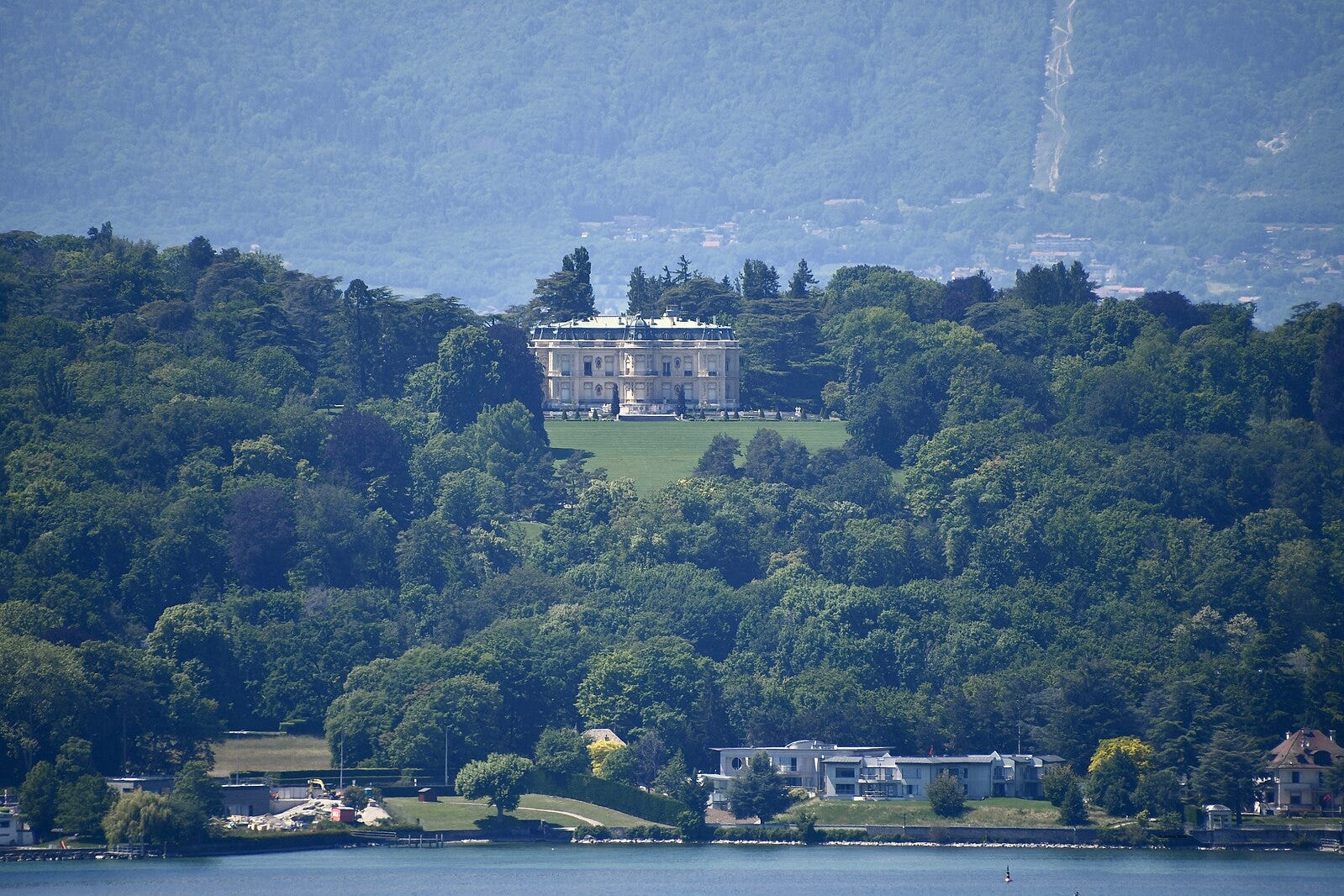

In other news, the Rothchilds stop fighting over art (at 93!) and give Switzerland Chateau de Pregny and all its accoutrements as museum to rival Le Louvre, in the spirit of "Le Douanier Rousseau"--an artist "who knew how to bide his time."