
Spring Books
What’s coming in April, May, and June.

Good morning! Welcome to this year’s first survey of forthcoming books.
There are some great titles scheduled for publication in the next few months. Let’s start with poetry since April is poetry month.
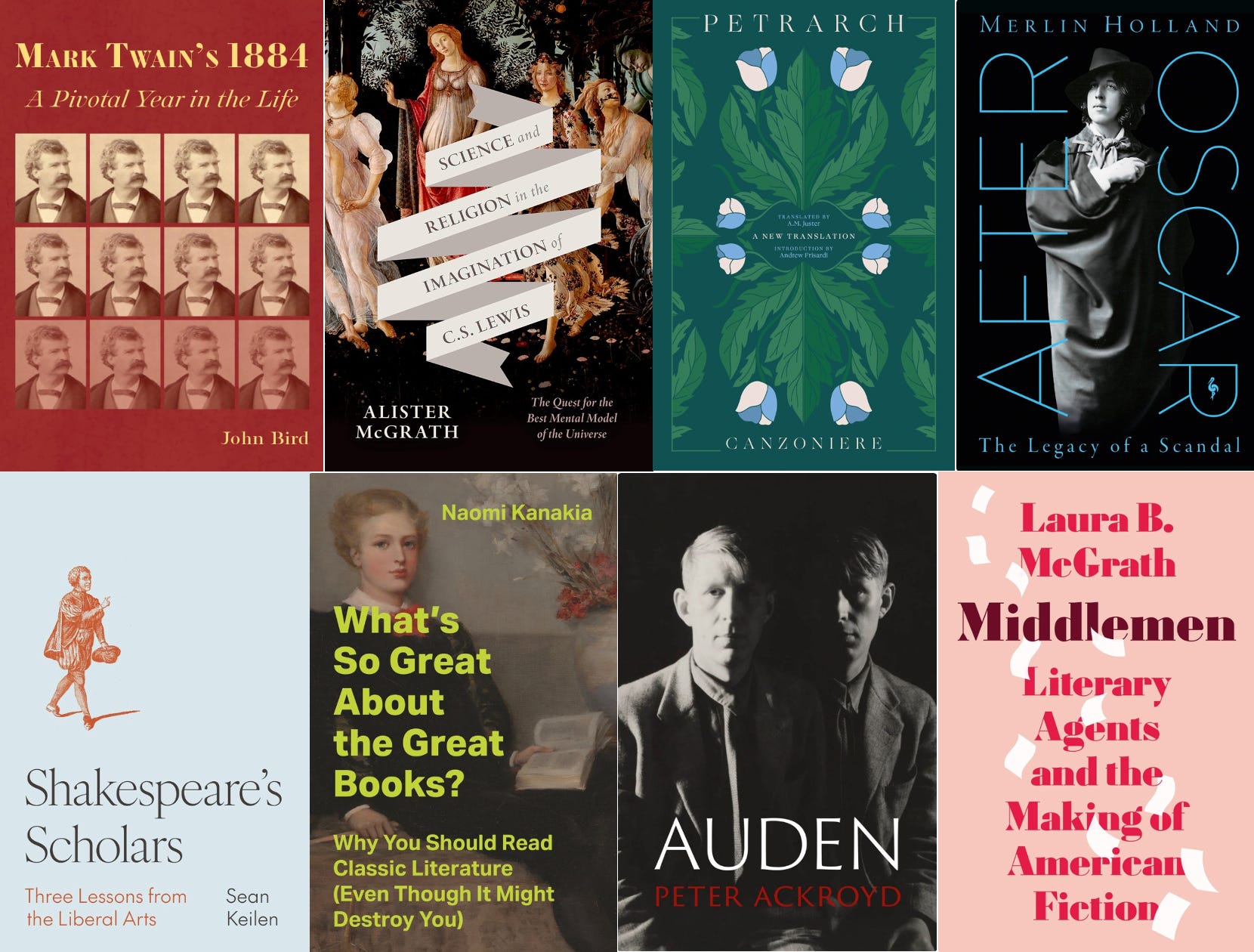
I have been looking forward to A. M. Juster’s new translation of Petrarch’s Canzoniere (Liveright, April 7) for some time. You will want to get a copy of it, too: “Petrarch’s Canzoniere stands as one of the greatest and most influential collections of love poetry ever written . . . In this monumental translation, the project of a lifetime, renowned poet A.M. Juster preserves the original text’s formal elegance, honoring Petrarch’s rhyme and meter while also capturing the profound religious and philosophical undertones that imbue the work. Rather than framing Canzoniere as mere “troubadour poetry,” this version, along with a panoramic introduction by Andrew Frisardi, highlights its classical roots and contemporary sensibilities.”
Simon Armitage’s verse translation of Gilgamesh will also be published by Liveright in April: “At once a story about love among men and a timeless meditation on loss, grief, and the longing to outlast death, Gilgamesh is at its core one of the oldest and most majestic depictions of human resilience and dignity. Now, in the hands of Simon Armitage, poet laureate of the United Kingdom, this primeval epic swells and flows in rhythmic, contemporary English with a vitality and immediacy that only a genuinely poetic rendering can achieve. Grounded in the latest scholarship but always propulsively readable, Armitage’s version brings the ancient text to new life, offering a new generation of readers a thrilling portal into the very dawn of storytelling.”
Malcolm Guite is not my cup of tea, but the first book of his new four-volume epic ballad Merlin’s Isle looks interesting. It is called Galahad and the Grail (Rabbit Room Press, April 20): “In this first volume of Merlin’s Isle, join the prophesied youth, Sir Galahad, and the other knights of the quest as they set out from Camelot to achieve the Holy Grail. The accomplishment of their goal will not only heal the wounded Fisher-King, but will bring about the long hoped-for healing of the land itself . . . Here at the height of his poetic power, Malcolm Guite delivers a tale of adventure in ballad form that plumbs the depths of the human soul, carries readers through the Wasteland, and sets them upon the numinous shores of Faerie in all its mystery and meaning.” The book contains 25 full-page illustrations by Stephen Crotts.
Other new books of poetry include: Julia Alverez, Visitations (Knopf, April 7), Amit Majmudar, Things My Grandmother Said (Knopf, April 14), and David Mason, Cold Fire (Red Hen, April 14).
Other books in April that look interesting are:
Daniel Hahn, If This Be Magic: The Unlikely Art of Shakespeare in Translation (Knopf, April 21): “How does Shakespeare remain Shakespeare when every word is changed? In this playful, meditative exploration of translating the world’s most beloved playwright, Daniel Hahn guides us through the magic of bringing the Bard to a global audience . . . Traveling the world, Hahn speaks to writers and actors engaging with Shakespeare’s work, sharing stories of his own. Hahn, whose great-grandfather produced one of Brazil’s earliest Shakespeare translations, emerges as a wise and enthusiastic guide, teacher, and sleuth. If This Be Magic does not require knowledge of any other language or more than a passing acquaintance with the Bard’s canon, but it draws out fascinating insights on both. As nerdy as they come (there is a chapter on commas), supremely readable, and funny throughout, this is a book for everyone and a fitting tribute to the Globe’s Bard.”
Jack Zipes, Once Upon a Time There Was Truth: Or, Why We Need Fairy Tales (Yale, April 21): “In this collection of essays on such beloved tales as ‘Hansel and Gretel’ and ‘Puss in Boots’; on the authors L. Frank Baum, E. T. A. Hoffmann, and the Brothers Grimm; and on the dubious influence of Disney, Zipes introduces readers to the history of the fairy tale and explores why the stories retain such a fierce hold on our imagination. He argues vigorously for the fighting utopian spirit the tales uphold--something our world sorely needs.” I am a little skeptical about the supposed “utopian spirit” of tales. Most are rather dark. Still, the book looks interesting.
Laura B McGrath, Middlemen: Literary Agents and the Making of American Fiction (Princeton, April 28): “Middlemen rewrites literary history from the perspective of one of its most important but least visible figures: the literary agent. Chronicling the story of agents in the United States from the 1950s to today, Laura McGrath uncovers their critical role in the making of American literature. From the famed three-martini lunch to the Frankfurt Book Fair, Middlemen takes readers behind the scenes to show how agents influence what we read.”
I am interested in the following simply because it is written by Oscar Wilde’s grandson: Merlin Holland, After Oscar: The Legacy of a Scandal (Europa, April 7): “Oscar Wilde died in November 1900, exiled in Paris, his reputation in tatters, exhausted by scandal and prison life. While the details of his life in the limelight are well known, often ignored are the reverberations of the Wilde scandal over the decades following his trial and death. With pathos, humor, and his grandfather’s signature wit, Merlin Holland charts the extraordinary afterlife of the legendary writer and thinker, tracing the dramatic fluctuations in Wilde’s posthumous reputation.”
Frank Callanan, James Joyce: A Political Life (Princeton, April 14): “The young James Joyce (1882-1941) was forged in the smithy of Irish political controversies, and he took into his European exile a depth of political insight unrivalled among his fellow modernists. In this biography of Joyce in his youth and early exile, acclaimed Irish historian and biographer Frank Callanan reveals a Joyce who is markedly more politically conscious, informed and complex than the Joyce of Richard Ellmann’s classic account. Written in a sparkling style and rich with historical insights, Callanan’s deeply researched biography is the first sustained account of how Joyce’s Irish and European political and cultural context shaped his life, thought, and writings.”
Robert Colls, George Orwell: Life and Legacy (Oxford, April 21): “George Orwell remains a work in progress. He is, or has become, a meme, a global writer, a national treasure, a London statue, a scholarly society, a Prize and a Journal, a trope and a show, various movies and murals, too many misquotations, two adjectives, at least half a dozen fictions, and most recently ‘a dead metaphor’ with plenty more accolades to come. George Orwell: Life and Legacy is an intellectual biography which offers an authentic account of Orwell’s life and work from his birth in the high noon of British imperialism in 1903, to his death on the eve of the Cold War in 1950--a life played out against a background of two world wars, the rise of communism, and the war-time pre-eminence of the United States. Yet no matter how alert he was to the world order, and no matter how guarded he was in his personal life, Orwell never shied away from the question of who he was, and the contradictions that entailed.”
Michael Murphy, Our World in Ten Buildings: How Architecture Defines Who We Are and How We Live (Atria, April 21): “We’ve been led to believe that purposefully designed spaces are something reserved only for those that can afford them. But in reality, all the spaces we inhabit—to work, to learn, to heal, and to live—have been planned and built to influence our lives. They sway our emotions, nudge our behaviors, protect us from disease, and do more, or less, to support shared prosperity and our sense of the common good. Our World in Ten Buildings unpacks this hidden but ever more important element of our lived experience. As author and architectural designer Michael Murphy takes us through ten milestone projects in his career he lays bare the physical, political, and intellectual labor at work shaping the world we live in.”
Andrew Graham-Dixon, Vermeer: A Life Lost and Found (Norton, April 7): “One spring day in 1683, a notary’s clerk in Delft entered the home of the late Magdalena Pieters van Ruijven and stumbled upon one of the wonders of the seventeenth-century world: twenty paintings by Johannes Vermeer. Rather than dispel the mysteries of Vermeer’s life, this discovery merely gave rise to more questions: How had this one Dutchwoman come to possess the majority of the master’s work? And why have these images--among the most beautiful, even sublime, in the history of art--defied explanation for so long? Following new leads and drawing on freshly uncovered evidence from Dutch archives, acclaimed art historian Andrew Graham-Dixon fills these long-standing gaps in art history, presenting a dramatic and transformative new interpretation of Vermeer’s life and work.”
Ross Barkan’s novel Colossus (Arcade) will be published in April—“a stark and unsettling portrait of success, in the vein of Philip Roth and Jonathan Franzen, that revives the long-established intersection between ambition and corruption in the pursuit of the American dream,” as the jacket has it.
Other novels in April that caught my eye: Tom Perrotta’s Ghost Town (Scribner, April 28), T. C. Boyle’s No Way Home (Liveright, April 21), Jay McInerney’s See You on the Other Side (Knopf, April 14), and Ben Lerner’s Transcription (FSG, April 7).
In May, we have:
Deborah Lutz’s This Dark Night: Emily Bronte, a Life (Norton, May 5): “Drawing on formerly inaccessible notebooks and manuscripts, This Dark Night constructs a portrait of Brontë, her famous writing sisters Charlotte and Anne, and the effect of their sisters’ and mother’s tragic deaths. In the first full-length biography in over twenty years, renowned scholar Deborah Lutz sketches the days of a woman crafting otherworldly fiction while running her father’s parsonage: writing interweaving with household work, daydreaming, and exploring the rough-hewn outdoors.”
Sean Keilen’s Shakespeare’s Scholars: Three Lessons from the Liberal Arts (Princeton, May 12): “Shakespeare was a keen and discerning reader who was mocked by writers who, unlike him, had been to university--so it’s not surprising that his portrait of scholarly life is critical. As Sean Keilen shows in this engaging book, Shakespeare’s scholars lack humility, shun wisdom, underestimate people who are not scholars, and, by keeping aloof from society, fail to see themselves clearly. In examining Shakespeare’s scholars, Keilen finds parallels in the modern academy.”
Harold Bloom’s The Man Who Read Everything: The Literary Letters of Harold Bloom, edited by Heather Cass White (Yale, May 5): “Bringing together a collection of Harold Bloom’s letters to and from eight of his favorite contemporary writers, Heather Cass White provides an intimate view of one of the most famous literary critics of the last century. In correspondence with Alvin Feinman, Northrop Frye, A. R. Ammons, John Hollander, James Merrill, John Ashbery, Henri Cole, and Ursula K. Le Guin, we see Bloom developing his groundbreaking theory of poetic influence, transforming himself into a public intellectual, and reckoning with the meaning of his own legacy.”
Joel Halldorf’s Reading Matters: A History for the Digital Age (NYU, May 26): “Considered one of the greatest inventions of human civilization, writing has served as a pathway to culture and education through history. The digital revolution has ushered in a dramatic transformation, leading to growing concern over the effects and possible detriments of algorithms, information overload, and fake news. In Reading Matters, Joel Halldorf makes the case that in order to navigate the upheavals of the digital age, we must understand prior technical revolutions and the transformations they engendered. He shows how our ways of reading are inseparable from the media we use, and that the decline of deep, attentive reading may be the most serious consequence of our move from page to screen.”
Naomi Kanakia’s What’s So Great About the Great Books?: Why You Should Read Classic Literature (Even Though It Might Destroy You) (Princeton, May 19): “A popular novelist and literary blogger answers those who claim the classics are too difficult, too problematic, and too white--and explains what we gain by reading them.”
H. W. Brands’s American Patriarch: The Life of George Washington (Doubleday, May 12): “From his early military career and role among the Virginia gentry, to his leadership during the American Revolution and reluctant return to public service as the first president of the United States, American Patriarch brings to life the man who was called on time and again by his peers to lead.”
Anthony Kaldellis’s 1453: The Conquest and Tragedy of Constantinople (Oxford, May 4): “Anthony Kaldellis offers a new narrative of the siege and fall of Constantinople in 1453, a watershed year that closed the book, once and for all, on the Roman Empire and confirmed for Europeans their worst fears about an expanding Ottoman Empire. By the fifteenth century, Constantinople had seen better days, but it was still a vibrant center of learning, worship, commerce, and information. 1453 sketches the tense but exciting shared world of Italians, Turks, and Romans that was thrown into crisis by Mehmed II’s decision to conquer the city. Kaldellis showcases a detailed reconstruction following events on a day-by-day basis, pulling from gripping eye-witness testimonies in Latin, Italian, Greek, Russian, and Turkish. He weighs the strategies of both the attackers and defenders, and proves that, contrary to the fatalism that marks almost all narratives written with hindsight, in reality the defense was hardly a lost cause. The defenders knew exactly what they were doing. They were willing to risk their lives, but it was not their intention to become martyrs. Instead, it was the sultan who was scrambling to neutralize a seemingly impregnable defense. That he did so was a testament to his ingenuity and tenacity.”
Adrian Goldsworthy’s Athens and Sparta: The Rivalry That Shaped Ancient Greece (Basic, May 12): “From an award-winning historian, the definitive history of classical Greece and the rivalry between its two greatest cities.”
Andrew Bayliss’s Sparta: The Rise and Fall of an Ancient Superpower (Norton, May 19): “For thousands of years, the ancient Greek city-state of Sparta has been famed as the ultimate warrior society. The flowing crimson capes and bronze shields of Spartan warriors remain the enduring image of masculine bravery, austerity, and toughness; King Leonidas’s 300 soldiers at Thermopylae the quintessential example of courageous self-sacrifice in battle. But who were the Spartans, really--and how did they rise from a humble village in the Peloponnese to become the dominant military power of ancient Greece? In this landmark new history, renowned Sparta expert Andrew Bayliss delivers a strikingly clarifying, relentlessly complex portrait of a culture and people long shrouded in myth.”
Isaac Fitzgerald’s American Rambler: Walking the Trail of Johnny Appleseed (Knopf, May 12): “As a child, Isaac Fitzgerald was always captivated by Johnny Appleseed, drawn by family ties to the legend, his father’s larger-than-life stories, and a shared restlessness to leave home and discover what lies beyond. In American Rambler, he sets out, walking from Massachusetts to Indiana on a year-long journey to follow Appleseed’s path, turning a childhood fascination into a profound reckoning of loss and grief, ritual and faith, grimy gas-station bathrooms and scenic apple picking. A moving blend of memoir, history, and travelogue, American Rambler is at once an ode to the American heartland and an antidote to the breakneck pace of modern life.”
And David Morris and Andrew Neill’s The Importance of Elgar: An Anthology (Boydell, May 12): “Of the many biographies and other books published about Edward Elgar few have brought together as many composers, performers, and writers as this anthology, in celebration of his art and life. Published to celebrate the 75th anniversary of the Society which bears his name, The Importance of Elgar brings together both executant musicians and others who share their love and appreciation of his music and what it means to them and, more widely, his place in the canon of western music.”
June is quite the month for literary and artistic biographies. We have Peter Ackroyd’s biography of Auden (Reaktion, June 5), Anna Arno’s biography of Paul Celan (Belknap, June 9), James Bailey’s biography of Muriel Spark (Princeton, June 9), Nick Triplow’s biography of Ted Lewis (Soho, June 2), and Peter Stanford’s biography of “God’s architect,” Antoni Gaudí (Hodder, June 2).
We also have:
John Bird’s history of Mark Twain’s 1884 (Missouri, June 22): “ Mark Twain’s 1884: A Pivotal Year in the Life is a ‘micro-biography’ that homes in on a single--and pivotal--year. In 1884, Twain stood at the height of his powers as a writer and enjoyed one of the happiest years in his domestic family life. During the course of the year he was readying his greatest work, Adventures of Huckleberry Finn, for publication, which occurred in England near the end of the year; he was launching his own publishing house, Charles L. Webster and Company, after becoming disillusioned with his previous publishers; and he publicly embroiled himself in presidential politics in a way that presaged his later involvement with American and international politics. Finally, Twain’s 1884 ended with a great deal more public exposure thanks to an extensive multi-city lecture tour he undertook with Geroge Washington Cable, as well as the beginnings of his ultimately successful attempt to secure publishing rights for Ulysses S. Grant’s memoirs.”
Jonathan Parshall’s history of 1942 (Oxford, June 5): “An engrossing and encyclopedic narrative of the year in which the outcome of World War Two hung in the balance.”
And Liaquat Ahamed’s history of 1873 (Penguin, June 2): “Over the course of the 1850s and 1860s, during the first era of globalization, the world experienced an unprecedented economic boom. Fueling this expansion was an explosion in the global bond market, at the hub of which stood one family—the Rothschilds, arguably the wealthiest banking family in history. While the giant sums of capital provided through the bond market built the railroads, the century’s most transformative investments, the money raised also unleashed a frenzy of speculation, massive overinvestment, and wasteful borrowing by governments. With excessive euphoria leading to disappointed expectations, in the early 1870s the bubble burst.”
Fay Bound-Alberti has a history of the human face (Grand Central, June 9), and Francis Young has a history of Fairies (Polity, June 2): “Before the rise of the ‘small winged fairy’ in the 19th century, the category of fairies included a vast range of supernatural human-like creatures, from the elves of Scandinavia and the aos sí of Ireland to the vilas of the Balkans and the fadas of Iberia. Young traces the ancient origins of belief in such creatures and how it adapted to the rise of Christianity and then flourished in medieval Europe, before being transformed - but not destroyed - by the upheavals of the Reformation, the Enlightenment, and even European colonial expansion, which made fairies a global phenomenon. He concludes this uniquely wide-ranging history by reflecting on the surprising ways in which fairy belief endures in our apparently disenchanted contemporary world.”
In fiction we have: Eric Cyr’s Here It Snows in June and Other Stories (Wiseblood, June 23), Clare Cavenagh’s Tillinghast (Viking, June 23), and Kevin Powers’s Children of the Wild (Harper, June 9).
Kate McLoughlin’s Silence: A Literary History (Oxford, June 26) looks interesting; so, too, does Elise Watson’s Print and Catholic Persistence in the Dutch Golden Age (Durham, June 30), though the latter is rather expensive! C. S. Lewis fans won’t want to miss Alister McGrath’s Science and Religion in the Imagination of C. S. Lewis (Oxford, June 11).
Happy reading!
an embarrassment of riches!
Thank you for this wide-ranging listing, most of which I would not have known.