
Saturday Links
Margaret C. Anderson’s life and work, the end of the New Statesman literary set, George Templeton Strong’s diaries, Paul McCartney’s photos, and more.

Good morning! In The Atlantic, Sophia Stewart reviews a new book about the life of the editor of The Little Review—Margaret C. Anderson:
From 1914 to 1923, Anderson’s life was inseparable from her work. “The ultimate reason for life is Art,” she declares in a 1916 issue of The Little Review by way of a mission statement. And she walked the walk: In the magazine’s early days, when its subscriber base had faltered because of Anderson’s anarchist sympathies, Morgan writes, she was “faced with a choice between keeping her magazine alive and keeping a roof over her head”—and so for six months, she lived in a tent on the banks of Lake Michigan, editing by firelight. But in the early ’20s, her youthful enthusiasm was eroded by the backlash to Ulysses, which had cost her both advertisers and subscribers even before the taxing trial and public censure. And when critics celebrated Beach’s edition of Ulysses, a book they had greeted with silence if not ridicule when Anderson serialized it, she took it as an insult. Thoroughly disenchanted, she saw that she was perhaps not cut out for a life so devoted to one’s work, that is, a career in the arts.
By 1924, Anderson writes in her 1951 memoir, “it wasn’t the Little Review that mattered; and it wasn’t Art that mattered any longer.” She was now interested in what she calls “an art of life”—a way of living that wrung every drop from existence by accumulating experiences. This renunciation of her editorial work doesn’t appear in A Danger to the Minds of Young Girls, though Morgan leans heavily on Anderson’s writings to scaffold the book. (He acknowledges, however, that she could be an unreliable if not outright mendacious memoirist: She claimed, for instance, to have spoken with F. Scott Fitzgerald at the office of his editor, Max Perkins, in 1913, when Fitzgerald would have been a teenager—years before he and Perkins actually met.) The half century that followed is a thornier, more muddled chapter in Anderson’s story: She led a peripatetic, often cash-strapped existence in France alongside her lover, the opera singer Georgette Leblanc (as well as several other paramours), before spending her later years as a self-described “recluse” in New York. She also spent decades in thrall to the spiritual leader George Gurdjieff, an Armenian-born mystic who preached divinity through labor.
The end of the New Statesman literary set:
They met in the early Seventies at The New Statesman: Hitchens worked there as a staff writer, Amis was literary editor, and Barnes his deputy. When he wasn’t on television, [Clive] James contributed book reviews. From the mid-Seventies to the early Eighties, the four of them met weekly in Soho for the now-legendary “Friday lunch”.
As Hitchens wrote in his memoir, Hitch-22 (2010), the Friday lunch was never planned, but “began to simply ‘occur’ … as a sort of end-of-the-week clearing house for gossip and jokes”. Other attendees included the up-and-coming novelist Ian McEwan, the poet James Fenton, the Observer literary editor Terry Kilmartin, the critic Russell Davies, and the elder statesmen Kingsley Amis and Robert Conquest (known affectionately as “Kingers” and “Conkers”). Much was made of this at the time, as Hitchens recounted: “we were believed to ‘control’ a lot of the reviewing space in London, and much envious and paranoid comment was made then, and has been made since, to the effect that we vindicated or confirmed F.R. Leavis’s nightmare of a conspiratorial London literary establishment.” Taking a line from Flaubert, who wrote after the deaths of his friends Louis Bouilhet and Sainte-Beuve that his “little band is diminishing”, Barnes writes in Departure(s): “the ‘little band’ to which I belonged when I came to literary London half a century ago has been thinned over the decades” and is “now beginning to die out”.
There is in this more than one ending: not just the death of each individual writer in turn, but the end of a whole era. Barnes, Amis and Hitchens were part of a new cohort of writers who brought British fiction and criticism out from the tearooms of the Fifties and Sixties and onto the world stage. No generation of novelists and essayists before or since has managed to combine aesthetic and intellectual ambition with outright commercial success in such a way — even the legends of modernism like Joyce and Woolf endured periods of relative obscurity. The vitality and interest of this new cohort’s work was made clear enough in spring 1983, when the literary magazine Granta published a special issue on the “Best of Young British Novelists”, with new fiction from 20 writers, including Amis, Barnes, McEwan, Kazuo Ishiguro, and Salman Rushdie. An accompanying group portrait was taken by Lord Snowdon and published in the Sunday Times Magazine. The photograph is striking: Adam Mars-Jones looking annoyed, Graham Swift impatient to leave, Amis in his school shirt, McEwan dressed like he has already reached retirement age.
Are we living in the Jack Edwards era of “criticism”?
Jack Edwards cannot quite deny being the most important literary critic in the world. In commercial terms, he certainly is. A nod from him fills bathtubs, train carriages and public parks with copies of a book he likes. Booksellers buy and arrange their stock to his taste. And he is not confined to new releases. When he dug up an obscure Dostoevsky (White Nights), his positive review moved it from cellars to shop windows instantaneously. I first met him for this interview around the time of the 2024 International Booker Prize. He had been asked to host the ceremony – and to livestream it. I watched him cruise up the red carpet, encircled by cameras and attendants.
Edwards is a literary tastemaker, but not in the familiar mode. You will not find any submissions of his languishing in the LRB slush pile. Instead he posts on BookTok and BookTube, the social media planes concerned with reading, where millions of viewers watch videos about books.
More:
Edwards is the foremost star of these platforms. Per his bio, he is the “internet’s resident librarian”. He is 27 years old and, on YouTube, has 1.5 million subscribers and 158 million views – which is roughly 16 and 1,755 Wembley Stadiums respectively. He is conventionally handsome, and excitable and sensitive in manner. He started YouTube while at secondary school in Brighton. His first videos were “day in the life” vlogs, study tips and A-level results reactions.
The boom came when he progressed to Durham University to study literature. His atmospheric recordings of undergraduate life proved so popular that the dean of his college now calls its oversubscription “the Jack Edwards effect”.
His next major growth spurt came when his university career ended. When Oxford University rejected his master’s application in 2020, Edwards posted a video of himself crying, entitled “oxford university rejected my masters application… (sorry this video is sad)”. Social media rewards confession. Authenticity, sincerity and vulnerability were important – more important than orthodox intellectual baubles. He described social media to me as “democratic . . . When you log on, you don’t need a qualification, you don’t need to be an established journalist.”
In praise of the Blue Ridge Parkway:
The Blue Ridge Parkway did something for my family that we could not reliably do for ourselves: it kept us quiet. During the North Carolina portion of my life, which ran from late 1989 until 2002, I came to think of those long drives as the only workable truce my parents ever managed. Everyone faced forward. The curves kept my bellicose father, who was driving, sufficiently occupied. The overlooks gave us sanctioned pauses, a reason to stop and take a leak without having to say why you needed to stop.
Harley E. Jolley’s The Blue Ridge Parkway, winner of the 1969 Thomas Wolfe Memorial Award, explains how this great mechanism3 was built. The book, which I’ve taught in several graduate seminars, was praised at the time for going “considerably beyond the scope of the usual guidebook,” though this understates the point. Jolley did archival work that might now be saddled with a ludicrous term like “deep dive.” His acknowledgments thank park officials, former superintendents, Senator Harry F. Byrd (you might recall the Virginia senator from Robert Caro’s elephantine LBJ series), Theodore E. Straus, Cherokee chief Jarrett Blythe, and others “sharing the wealth of their personal knowledge.” His bibliography lists interviews with park engineers and claims adjusters, Cherokee agency files, stenographic reports of routing hearings. He understood that bureaucracies tell great stories, often unintentionally, and knew where to look for them.
It is widely understood that exclamation points must be inserted into the modern professional email at precise intervals — just enough to create a tone of eagerness and warmth without tipping over into sounding fake, sycophantic or batty. So people appeal to the internet, terrified they’re hindering their careers by striking the wrong balance; they seek advice from job coaches; they joke about their obsessive budgeting of exclamations. They fear seeming overexcited, yes — but they also know the risks of the plain old period. Too brusque. Too cold. Too testy.
It has been this way since soon after the smartphone arrived, when older Americans started getting the unwelcome news that ending their messages with periods was a grave faux pas. This must have been a baffling experience, like being called gross for drinking water or flossing. But a new tonal consensus really had emerged: The period seemed pointed, stern, passive-aggressive. By 2013, this shift was ingrained enough that The New Republic ran an article celebrating the period’s newfound role as a jerk.
Poem: Benjamin Myers, “The Burial of the Faithful”
Jeremy Black reviews a new history of Mexico:
An impressive and confident history of Mexico from the Aztecs to the present, Paul Gillingham’s Mexico: A 500-Year History is at once well-written and yet also somewhat unbalanced. The central theme, one of Mexico as a particularly hybrid society that has confronted major challenges and, in doing so, had better results than citizens of the United States generally allow for, is argued through with conviction. This begins with the start of Spanish America. There is a very impressive section on the Spanish conquest that brings out its violence and destructiveness, but also the very heavy dependence of the Spaniards on native cooperation, and the extent to which existing elites remained significant. Spanish Mexico is presented as in part a matter of islands of control.
There is a similar account of Christian conversion, with violence again to the fore, notably in the deliberate large-scale destruction of indigenous religious practices and personnel. At the same time, the impression given is very much one of the superficial character of Christianization and, again, of a hybrid creation in which very much remained from before. This is unsurprising because, as Gillingham points out, there were relatively few missionaries and many rapidly died. (It was the missionaries who were the key agents of change; the parish priests proved far less active.)
More generally, despite the disastrous effects of a range of new diseases on the native population, with Gillingham being particularly descriptive of smallpox, the Spaniards remained a marked minority. As a result, the ethnic mix was very different from that of English North America. There, a high survival rate among European immigrants ensured a reasonable gender balance, which, in turn, increased the European population. The situation was very different in the English Caribbean and for the Spaniards. Only so many wanted to settle, many pushed on to South America, and there were more convenient opportunities in Spanish Italy and the Spanish Netherlands.
Luke Lyman reviews Brooke Allen’s collection of essays: “Fifty-four percent of American adults read below a sixth-grade level. As Brooke Allen laments in Good Bones, we are becoming a postliterate society. But she’s not giving up on us without a fight. Her superb collection of essays gathers up relics of the old world—the literate one—to demonstrate that such treasures are worth preserving.”
Geoffrey C. Ward reviews a new collection of George Templeton Strong’s diaries:
When George Templeton Strong, a prominent Wall Street attorney, died at 55 in 1875, the New York Tribune’s obituary dutifully listed his gentlemanly contributions to the cultural life of his city. He’d been a Columbia College trustee, a Trinity Church vestryman, president of the Philharmonic Society, co-founder of the Union League Club. But overall, the writer added, Strong had led “a very quiet life,” and while his many friends remembered that his love of “elegant literature” had superseded his interest in the law, “he was not the author of any extensive literary work.”
It would be decades before anyone realized how wrong his friends had been. For 40 years, from the age of 15 until a few days before his death, Strong kept a journal—2,250 pages, well over 4 million words—that, according to the literary scholar Daniel Aaron, made him “the most readable and brilliant of . . . nineteenth-century American diarists.”
A history of “hello”: “In print, this ubiquitous, friendly greeting has a surprisingly short history. Two centuries ago, on 18 January 1826, ‘hello’ made what is thought to be its earliest recorded appearance on the page, in a Connecticut newspaper called The Norwich Courier. Hidden among the column inches, it was a modest in-ink debut for a word that would go on to greet much of the modern world.”
An unfinished Leonardo mural briefly goes on display in Milan: “As Milan prepares to host the 2026 Winter Olympics, the city is briefly unlocking access to an elusive Leonardo da Vinci work: a vast, unfinished wall and ceiling painting hidden for centuries inside the Sforza Castle, which is normally concealed behind scaffolding as it undergoes restoration.”
The renovation of “America’s Notre Dame”:
Gargoyles have watched over this small Kentucky city for more than a century from their lofty perches on a cathedral known as “America’s Notre Dame.” A new renovation will ensure they keep their posts for years to come on the meticulously restored facade of the towering stone sanctuary.
Workers in recent weeks have been installing new terra cotta gargoyles as one of the final steps of a major, two-year restoration of the Cathedral Basilica of the Assumption. The Catholic cathedral’s nickname stems from how its exterior was modeled on the larger Notre Dame Cathedral in Paris — from the pointed arches and flying buttresses to the gargoyles and chimeras with their reptilian grins and piercing, canine eyes.
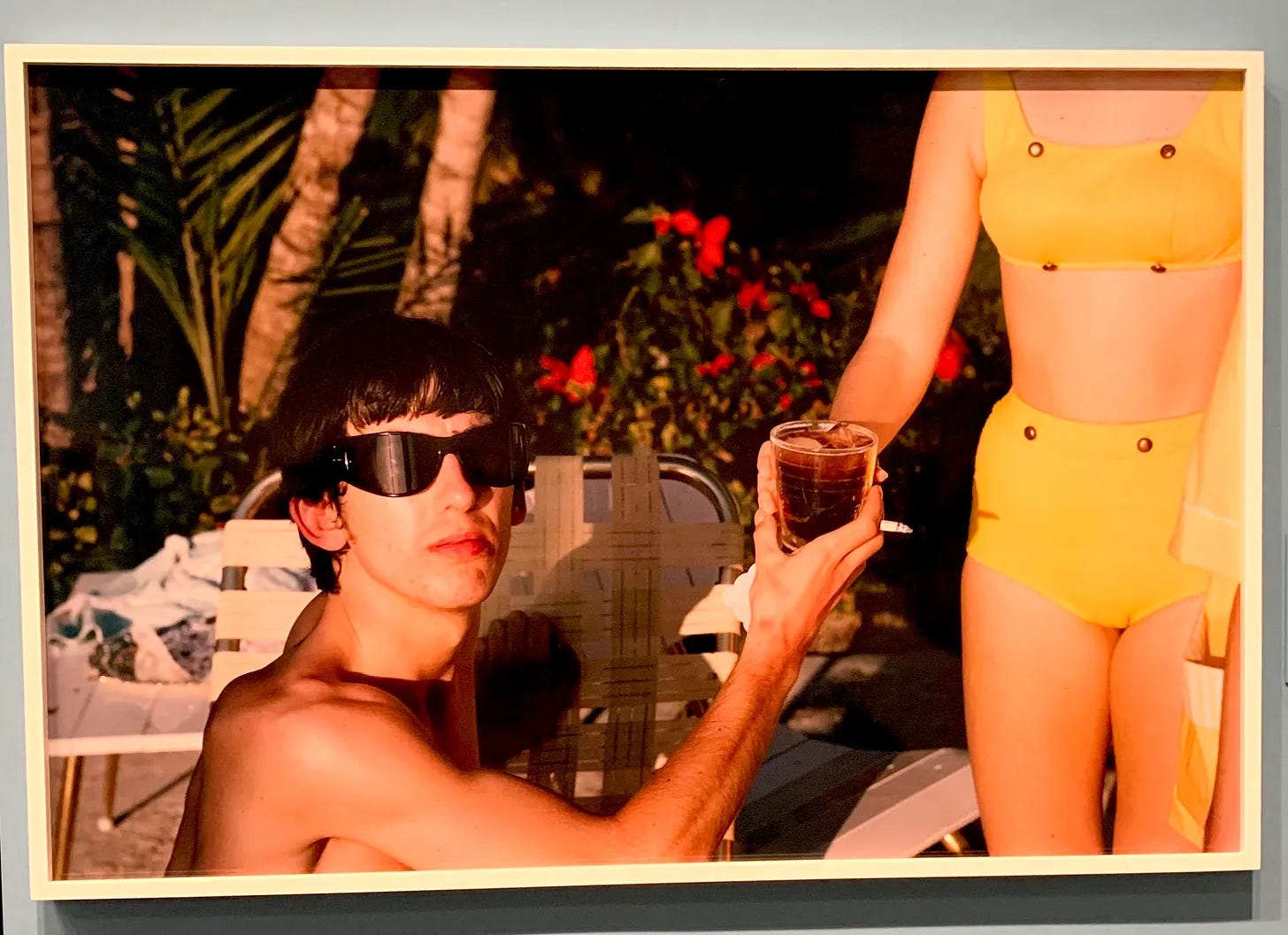
Paul McCartney’s photographs: “Eyes of the Storm: Paul McCartney Photographs, 1963–64 showcases a selection of nearly 1,000 recently discovered photographs taken by Paul McCartney with his Pentax during the period in which the Beatles went from being aspiring musicians in Liverpool to white-hot international celebrities. Before Beatlemania took the world by storm, McCartney recorded candid portraits of bandmates George Harrison, Ringo Starr, and John Lennon as they began performing with other acts before moving on to Paris. It wasn’t the first trip to Paris: In 1961, McCartney and Lennon arrived as hitchhikers, dazzled by monuments and boulevards and taking in a concert by Johnny Hallyday, France’s answer to Elvis Presley.”
Who was Weldon Kees? Watch this intriguing documentary of the poet presented by Dana Gioia.
Forthcoming: Frank Callanan, James Joyce: A Political Life (Princeton, March 24): “The young James Joyce (1882–1941) was forged in the smithy of Irish political controversies, and he took into his European exile a depth of political insight unrivalled among his fellow modernists. In this biography of Joyce in his youth and early exile, acclaimed Irish historian and biographer Frank Callanan reveals a Joyce who is markedly more politically conscious, informed and complex than the Joyce of Richard Ellmann’s classic account. Written in a sparkling style and rich with historical insights, Callanan’s deeply researched biography is the first sustained account of how Joyce’s Irish and European political and cultural context shaped his life, thought, and writings.”
This email always inflates my tab at the bookshop. And ... the Ben Myers poem is fantastic.