
Saturday Links
The poetry of Weldon Kees, a history of money, Johnny Depp’s “Master and Margarita,” the 2025 Turner Prize, and more.

Good morning! Derek Robertson reviews Helen Dewitt and Ilya Gridneff’s “meta-autofictional epic,” Your Name Here:
DeWitt is the author of, among other books, The Last Samurai, published first in 2000 to glowing reviews, and fêted after its 2016 republication by New Directions Publishing as a modern classic . . . The praise is warranted: A fiery jeremiad about cultural sloth, ignorance, and oppression disguised as a hyperliterate coming-of-age story, the book is unlike any other, inspiring a passion bordering on evangelism in its devoted fanbase that seemingly grows by the year.
Since then, DeWitt has produced the satirical novel Lightning Rods, published by New Directions in 2011, but written more than a decade prior, and a short story collection and novella, also published by New Directions. Your Name Here was first self-published as a PDF by DeWitt in 2008; n+1 excerpted the first chapter, calling it “an important and complicated work of art which unjustly has not yet been able to find a publisher in the United States or England,” while in the London Review of Books Jenny Turner lauded its complexity as “a novel that doesn’t really believe in novels.” Ultimately, no publisher was willing to take the risk on such a work until DeWitt’s new agent sold it to Dalkey in 2022, as the New York Times reported in a recent profile.
In the realm of the physical, bearing a jacket quote from literary it-girl Lauren Oyler, and comparisons to Charlie Kaufman’s Adaptation. (2002) and Italo Calvino’s labyrinthine If on a Winter’s Night a Traveler, the book feels like the unwieldy, bespoke object that it is. It is ever so slightly taller than a traditional paperback, clumsy to hold even in your critic’s outstretched, bass guitar-playing hands. There are unpredictable changes in font, font size, font color, the didactic use of Arabic script, and the aforementioned and poorly rendered photographs of tabloid stars. Like Calvino’s story, referenced at length in the text of the book itself, it constantly reminds you that you are reading a book. To what end?
Peter Hitchens writes about memorable car trips in The Lamp: “Perhaps my mother was not a very good driver. Of course, I have known this factually for many decades, but we all cling, as long as we can, to our infant beliefs that our parents are faultless and heroic, as in many important ways they are and will forever remain. Only when we find our own great faults are we properly equipped to see the small failings in our mothers and fathers. Also, I am not a very good driver myself, so I am in no position to criticize. It is just a fact. But her lack of skill at the wheel contributed to two of my most vivid recollections, preserved in full color, with sound, standing out in the fog which is, in general, my memory.”
Who was Weldon Kees? Dana Gioia writes about discovering this “satiric and terrifying, intimate and enigmatic” poet:
I first discovered the poetry of Weldon Kees in 1976—fifty years ago—while working a summer job in Minneapolis. I came across a selection of his poems in a library anthology. I didn’t recognize his name. I might have skipped over the section had I not noticed in the brief headnote that he had died in San Francisco by leaping off the Golden Gate Bridge. As a Californian in exile, I found that grim and isolated fact intriguing.
I decided to read a poem or two. Instead, I read them all, with growing excitement and wonder. I recognized that I was reading a major poet. He was a head-spinning cocktail of contradictions—simultaneously satiric and terrifying, intimate and enigmatic. He used traditional forms with an experimental sensibility. He depicted apocalyptic outcomes with mordant humor. I had found the poet I had been searching for. Why had I never heard of him? Embarrassed by my ignorance, I decided to read everything I could find by and about him.
Johnny Depp announced he will produce the first English-language adaptation of Mikhail Bulgakov’s The Master and Margarita (the latest Russian version was released last year): “The project, which currently does not have a director attached, is being produced by Depp’s own IN.2 Film shingle in tandem with Jeanne du Barry executive producer Svetlana Dali and Grace Loh.”
Ayoush Lazikani writes about the moon in medieval Christianity and Islam: “At the simplest and most straightforward level, the Moon emerges in art and poetry as a way of indicating the workings of the Divine within Creation. For example, the Moon appears in scenes representing vital stories in Christian history, emitting its glow at crucial moments of the Christian salvation narrative. The Moon features in many scenes of the Passion of Christ and of the Last Judgement, where it accompanies the Sun. Here, Moon and Sun together serve to show the deep and reverberating cosmic significance of these moments in Christian history. Examples of such illustrations include the Crucifixion scenes in the Book of Pericopes (a book of biblical passages) and the Sacramentary (a book of liturgical excerpts) for King Henry II in the 12th century . . . As we turn to Islam, we find the Moon associated intimately with the Prophet Muhammad and even God himself. In this association, the Moon is linked both to Allah and to God’s dignitaries on Earth, and the central role these latter individuals play in propagating religious belief.”
Poem: A. M. Juster, “The Ruin”
Why the Shipping Forecast endures: "
In 2025, the Shipping Forecast . . . celebrated its centenary. Since its first broadcast on BBC Radio 4 in July 1925 as a service to all mariners in UK waters, it has assumed national treasure status. Its aim is to provide a guide to what the weather is most likely to do for the next six hours in each of the 31 specified sea areas surrounding the British Isles, from south-east Iceland, just below the Arctic Circle, to Trafalgar, just above Africa. The forecast follows a strictly formatted sequence of measurements. First, the warnings of gales scaled from one to 12, then a “general synopsis” or overview for all UK waters, then an area-by-area forecast of wind strength and direction (“northwesterly four to six, increasing six to gale eight”), sea state (“moderate or rough, becoming mainly very rough”), the weather (“showers, becoming wintry”) and finally visibility (“good, occasionally poor later”). Each forecast takes precisely nine minutes to read.
Produced by the Met Office on behalf of the Maritime and Coastguard Agency, the Shipping Forecast is now one of the longest-running radio programmes in the world. Its beauty lies partly in its division of oceanic chaos into reasonable scales and partly in the comfort of knowing that however unpleasant your job or your journey to work may be, it’s as nothing to a storm force ten to the north of Rockall. Perhaps only the weather-obsessed British could have turned a weather forecast into a national totem, but even in its recently reduced form on FM radio (two out of four daily broadcasts are now long wave only) it still provides a service to lyricists, armchair sailors, and insomniacs everywhere.
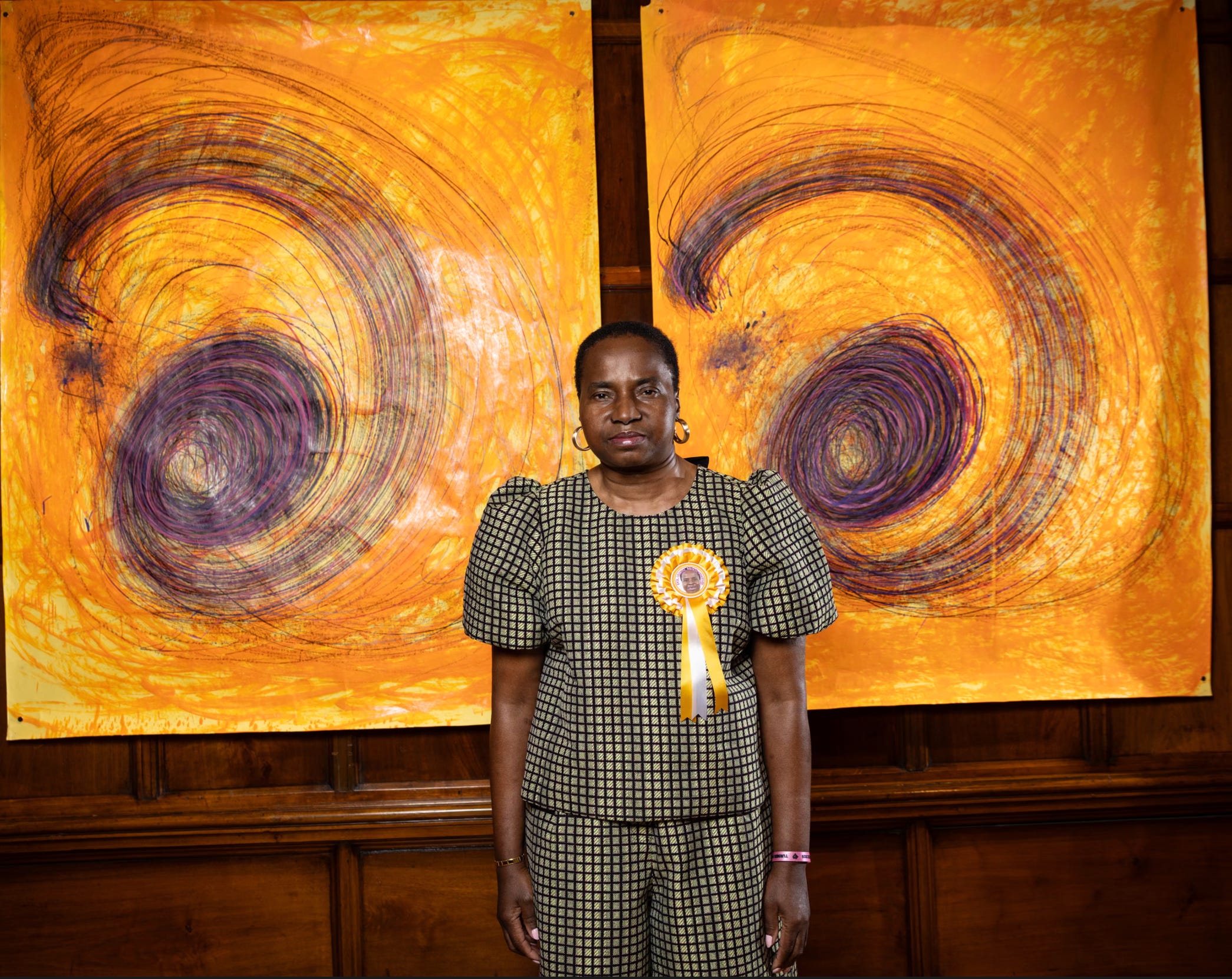
Nnena Kalu has won the 2025 Turner Prize. Evan Moffitt takes stock of her work:
Kalu’s abstract, charcoal drawings and hanging sculptures, the latter fashioned from colourful paper, gaffer and VHS tape, are the least overtly political of the works by the four nominated artists yet by far the most politicised. That’s because the 59-year-old Glaswegian is learning disabled. Autistic with limited verbal communication, she has not provided curators or critics with an interpretive framework for her practice. Her art must speak for itself.
That has made some people uncomfortable. The Times’s art critic, Waldemar Januszczak, decried the judges’ decision as “virtue-signalling”, writing that “it is not the job of art to confuse therapy with talent. Nor is it the task of the Turner prize to play doctors and nurses or involve itself so flagrantly in the collection of medical Brownie points.” In the Telegraph, Alastair Sooke was more measured, accusing the panel of a “collective act of goodwill” rather than “tough-minded aesthetic judgment”.
Kalu’s supporters also appeared to put the artist before the art. “This is a major, major moment for a lot of people. It’s seismic. It’s broken a very stubborn glass ceiling,” Kalu’s studio manager, Charlotte Hollinshead, said during the award ceremony.
So what of the art, then? I’ll admit I dismissed it too, before I made the trip to Bradford to see it in person.
Konstantin Kakaes reviews Michael D. C. Drout’s The Tower and the Ruin: J.R.R. Tolkien’s Creation: “Tolkien argued that although Beowulf, the poem, narrated important episodes in the life of Beowulf, its hero, the point was not to tell a story or give a biography but rather to use the ‘knowledge of these things for its own purpose—to give that sense of perspective, of antiquity with a greater and yet darker antiquity behind.’ Mr. Drout’s thesis is that Tolkien set out to achieve a similar effect. ‘The basic premise of this book,’ he writes, is that Tolkien’s writings ‘are qualitatively different’ from most other works of 20th-century literature. Reading Tolkien often feels like ‘entering a world rather than just reading another book.’”
An unshakable monument in the history of world cinema, Sergei Eisenstein’s Battleship Potemkin opened 100 years ago this December, at the Bolshoi Theatre in Moscow. Ever since its re-release in the early 1950s, Battleship Potemkin has been consistently rated among the greatest films ever made, and has influenced numerous creative artists, from the notorious Leni Riefenstahl in her propagandist documentaries to the painter Francis Bacon, who was inspired by the agonizing images of the Odessa Steps sequence, as was Brian De Palma in making the railroad-station scene in The Untouchables.
Lenin declared that “of all the arts the most important for us is the cinema,” and Eisenstein ranked high among the many directors urged to produce propagandist films. He was still in his mid-20s when he made, within the space of 12 months, both Strike and Battleship Potemkin, two of the mightiest peaks in silent cinema. Both films were intended as a rousing call to arms, looking back at events of 1903 (Strike) and 1905 (Potemkin) as harbingers of what would become the Russian Revolution of 1917. Eisenstein, at work on a study of the First Cavalry Army’s part in the Civil War (1917-1922), was assigned to film a scenario that covered the revolution from the struggle with Japan to the domestic upheavals in Moscow. But he preferred to concentrate all his attention on the mutiny aboard the Potemkin in June 1905.
James Grant reviews a new history of money: “Now here is a book. It instructs and provokes and entertains. Even its mistakes are worthwhile. The secret of The History of Money is in the subtitle: ‘a story of humanity.’”
Forthcoming: Marcus Aurelius, Meditations, translated by Aaron Poochigan (Liveright, January 6): “Acclaimed poet and translator Aaron Poochigian’s vibrant new translation of Marcus Aurelius’ Meditations captures and accentuates an aspect of the best-selling work of classical antiquity that other English translations have, remarkably, overlooked: Marcus’ distinct, varying voices. There’s Marcus the aspirant, speaking encouragingly to himself as a diarist might; Marcus the instructor, exhorting and chiding himself as a ‘you’ that includes us all; Marcus the stylist, spinning memorable, quotable epigrams; and Marcus the philosopher, opining about the ‘human commonwealth’ of which we are all members. This multivocal chorus is apparent to all who can read the original Koine Greek text, but Poochigian’s sensitive ear has captured it in English as no translator has before. The result is a Meditations that is as pleasurable to read as it is profound—a revelation even to readers who think they know it well.”