
Saturday Links
Book clubs, John Aubrey at 400, the life and work of Franz Rosenzweig, in praise of truckers, and more.

,_by_Eduard_von_Gr%C3%BCtzner.jpg)
Good morning! I said on Monday that a big announcement would be coming this week. It turns out it will be next week, but it is coming!
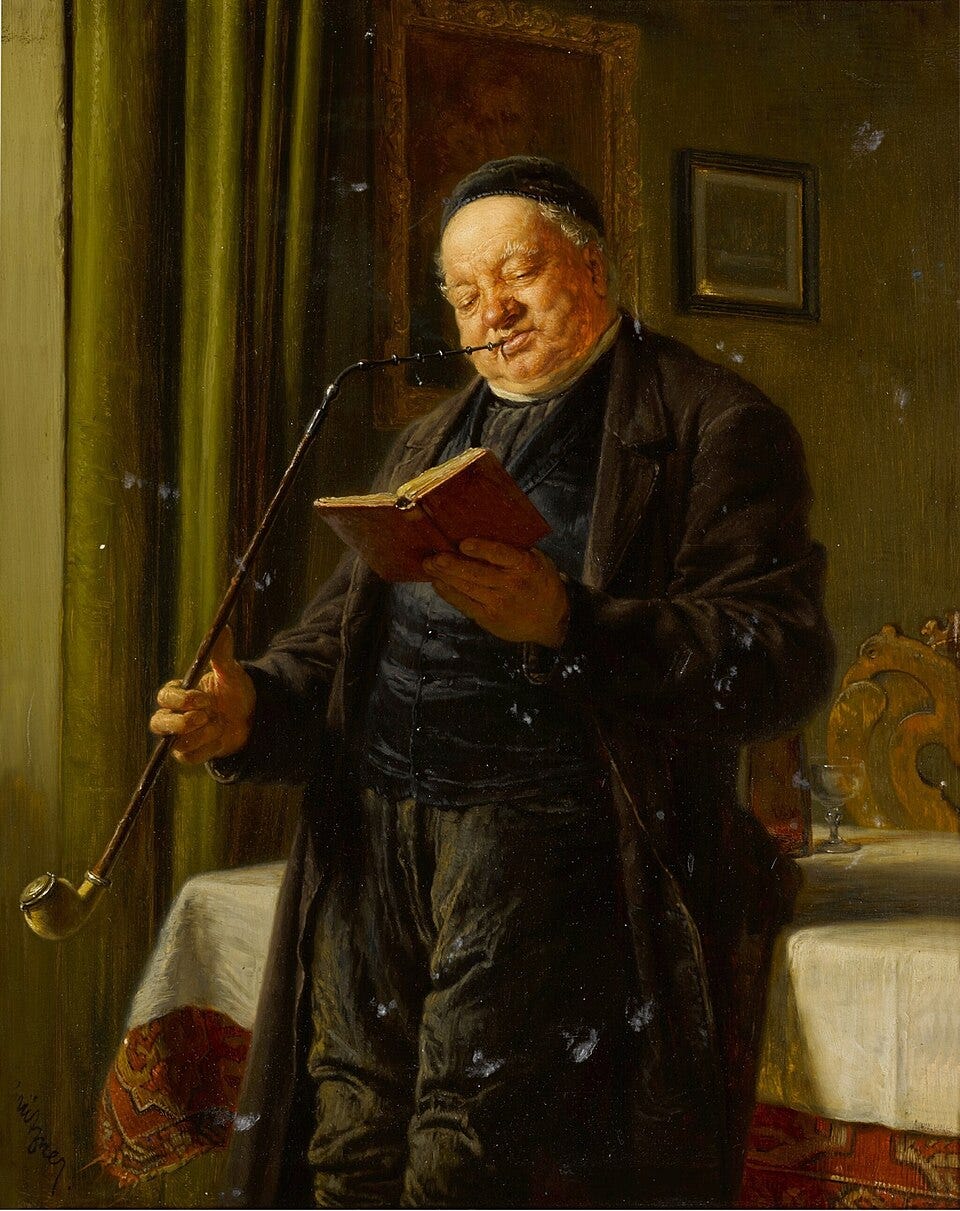
Rob Long writes about his book club in the Washington Examiner: “Every book club has a jerk in it. If you don’t know who that is in yours, well, I have some bad news for you. But I have some good news, too. The people in the club with you, if you’ve chosen your friends wisely over the decades, already knew you could be a jerk. They already knew you’d propose some pretentious titles and lose it over nothing. And they still want to be in the book club with you. Because the best book clubs are never really about the books.”
And Kristopher Jansma writes about his book club at Lit Hub:
The decline of male readership has been linked to all other kinds of societal ills: social media addiction, the rise of the Manosphere, the end of democracy. You’d get the impression that if only more men would read books—or if only someone would just make “books for men” again—then all our other problems would be solved.
May I just say that I find all of these hot-takes to be completely absurd. At least my own experiences this year with my book club haven’t borne a single one of them out.
I’ve never heard any of my guys lament the impracticality of fiction; no one struggles to find interesting books without Reese Witherspoon’s seal of approval; no one decries a lack of sufficiently “macho” material at the local Barnes & Noble.
What they enjoy reading is also surprisingly varied, ranging from genre fiction to classics to contemporary literary novels, as likely to be plucked off a New York Times list as recommended by a Reddit thread.
Speaking of men, Michael O’Donnell reviews Tom Junod’s In the Days of My Youth I Was Told What It Means to Be a Man:
You couldn’t invent Lou Junod (1919-2006). A leather-goods salesman from Brooklyn, N.Y., he worshiped the sun and loved nothing better than a “fresh burn.” He carried a solid-gold money clip shaped like an Oscar statuette. After a grenade almost killed him in Normandy, he earned a Purple Heart and then sang in the jazz clubs of Paris. He once ran into Cary Grant at a showroom in New York; the two acknowledged each other as equals. A well-scented man, Lou stocked his bathroom with rows of tonics and lotions. As he told his youngest son, pausing for emphasis, “they can’t keep their eyes off . . . your father.”
The son in question is Tom Junod, a magazine journalist who spent time at Esquire and now writes for ESPN. Mr. Junod’s In the Days of My Youth I Was Told What It Means to Be a Man is one of the great literary tributes to a complex paterfamilias in recent memory . . . The question Mr. Junod explores is whether his father was a scoundrel or merely a rascal. In other words: Was he forgivable or not? “He was a scrupulously superficial man, believing so fervently in the magic of surfaces that his fervor almost passed for profundity,” Mr. Junod writes.
Benjamin Balint reviews Paul Mendes-Flohr’s Love Is Strong as Death: A Biography of Franz Rosenzweig:
In 1918, from the trenches on the Macedonian front, a 31-year-old German artilleryman sent his mother postcards covered in fragments of a philosophical system. From these narrow scraps grew The Star of Redemption, an audacious 1921 book conceived under fire that asks what remains of love—both human and divine—after war has marched a continent into the mud.
Paul Mendes-Flohr’s compact, beautifully rendered biography of Franz Rosenzweig, Love Is Strong as Death—completed shortly before Mendes-Flohr’s death, at age 83, in October 2024—follows those postcards back into the life that produced them and forward into the afterlife they helped create. Mendes-Flohr was a pre-eminent scholar of modern Jewish thought and a student, at Brandeis University, of Rosenzweig’s pupil Nahum Glatzer. Here Mendes-Flohr shows how Rosenzweig’s story condenses a larger drama: the brief renaissance of German Jewry in the final, doomed years of the Weimar Republic (1919-33), with its ambitions and anxieties articulated in one brilliant man, acutely aware of his own finitude.
John Aubrey at 400: “Whenever I approach the blind corner on the path south of my house in Oxford, I ring my clear-toned bicycle bell and think of John Aubrey, who noted in the 17th century that church bells sound clearer after rain (which was true for my little bell today). I have often also passed on to tense students approaching their final exams Aubrey’s excellent advice that you are ‘more apt to study’ if you’ve played a gentle game of real tennis (or some less real modern equivalent). And whenever I find myself on a coach to London passing through St Clement’s, I remember Aubrey’s note that ‘St Edmund, Arch-Bishop of Canterbury did sometimes converse with an Angel, or Nymph, at a Spring without St Clements Parish near Oxford’. There is no end to the ways in which Aubrey’s writings enchant the townscape: recently, while drinking coffee in Golden Cross yard, I heard a tour guide rehearsing the tale of Shakespeare stopping with the poet D’Avenant’s parents at their tavern here. Every word of his patter was derived from Aubrey’s inexhaustible Brief Lives (1669–96).”
Poem: James Matthew Wilson, “Hard Stop”
Christopher Beha writes about utilitarianism and the purpose of life in Compact:
Treating individuals as components of an aggregate crowd is precisely the utilitarian way, but Mill recognized the approach’s limits even as he continued to advocate for utilitarian ethics. From the outset, Mill understood a fact about liberalism that remains true today: It is unmatched as a system for allowing people with vastly different conceptions of the good to live together peacefully, but it struggles to generate a conception of the good that people will find satisfying.
For his own conception of the good, Mill came to draw on the Romantic ideal of the energetic, great-souled individual who stands out from the crowd. His ultimate defense of this figure, however, remained thoroughly utilitarian. Each individual is the best judge of what actions will bring him happiness, and so the greatest-happiness principle requires the maximization of personal choice. When we allow ourselves to be shackled by custom, we limit our choices, and society as a whole loses out on the example of our experiment. Mill’s personal experience synthesizing the Enlightenment and Romantic traditions had taught him that arriving at truth often means “reconciling and combining opposites,” a process that occurs through “the rough process of a struggle between combatants fighting under hostile banners.” Mill saw free human choice and the contest of ideas as means of social progress.
Lora Kelley reviews Stefan Fatsis’s Unabridged: The Thrill of (and Threat To) the Modern Dictionary:
The thrust of Fatsis’s memoir—broken up with history lessons and charming, if slightly disjointed, profiles and dispatches from dictionary-related events—is a recounting of his time embedded in the Merriam-Webster offices during a stretch of great linguistic and economic change. During his apprenticeship as a professional lexicographer, which spanned the late Obama and early Trump years, Fatsis harbored many pet projects and words that he wanted to add or update, which included gender pronouns, sports terms, trending political words, and adolescent humor. Fatsis demonstrates how words get added to the dictionary through his own confident but oft-foiled efforts to get his definitions in. Sometimes, his climactic encounters with language reflect words in “the current cultural stew”—for example, the then-emerging terms safe space and microaggression. (His pride at getting these words into the dictionary curdles into contrition when, a few years later, after the killings of George Floyd and Breonna Taylor, he muses that “a microaggression is whatever its recipient says it is.”) But just as often, his submissions merely reflect his own interests: He spends time on the slang terms Dutch oven (as when someone farts under the sheets) and fluffer (the person who keeps porn actors hard on set). He fixates on getting sportocrat into the dictionary, grasping for usage examples; he lavishes attention on slurs, taboos, and the obscene.
Fatsis is open about both his ambitions and his skepticism of the dictionary’s fusty ways. As he works on his definitions, he bristles against edits and faces negative feedback, suggesting more than once that the dictionary might consider shaking things up a bit. “While I respected the Merriam process,” Fatsis notes as he heads to the company’s offices in drab Springfield, Massachusetts, “I also copped to a selfish, subjective quest to scribble my initials on the language.” His failure to get ze past the gatekeepers “pushed [him] to the belief that there are times when The Dictionary benefits from flexibility, when it’s okay to welcome a word that might just fall short of its ingrained standards—or might change those standards.” After causing a PR headache for Merriam-Webster, he writes, “I wasn’t predisposed to the inoffensive, the way a seasoned definer would be. I thought a funny, cutting, sexy, or culturally relevant quotation could say more about how we use language than a vanilla sentence devoid of context.” Stephen Perrault, a staid, stalwart editor who keeps Fatsis at bay, counters: “We’re not looking to be provocative.”
Fatsis is, though. Throughout this book (and in subsequent writing), he flirts with the narrative that Merriam-Webster is in big trouble, as “another early twenty-first-century digital media outfit battling to survive an increasingly bookless world,” goosing traffic with games and spinning toward obsolescence. He writes, concerning the dictionary’s years of struggle, that “I was never rooting for that story, just chronicling it,” adding that he was glad to see the clicks and revenue recover. Still, it’s hard to shake the sense that Fatsis is skeptical about its future and keen to sniff out doom . . . After spending hundreds of pages bouncing around with him—watching his thinking on language evolve in accordance with political trends and personal hang-ups, seeing him get the proverbial bee in one’s bonnet or take a stand or get carried away—I have to say: The editors’ resistance to Fatsis’s interventions serves as a convincing testament to their process. The good book is going strong. It maintains its standards yet.
Mark Bauerlein surveys new books of Christian history: “Several books on some aspect of the history of Christianity have recently come my way. ‘The Most Dangerous Man in England’: Newman and the Laity, by Paul Shrimpton, provides a record of Newman in action. We learn about Newman’s work in setting up and directing an English oratory in Birmingham; his founding and leadership of the Catholic University of Ireland; his editorship of the Catholic journal The Rambler; and his response to Vatican I and acceptance of the red hat (after an initial refusal). Throughout the story, Newman stands as a firm defender of the laity. In Shrimpton’s words, he was a ‘guide of souls’ who ‘put himself among his flock, walked with them.’ . . . In Reinventing Protestant Germany: Religious Nationalists and the Contest for Post-Nazi Democracy, Brandon Bloch focuses on a narrow time and small group of people: Protestant intellectuals in Germany who were key figures in political reconstruction after the war. ‘Protestant political activism rarely deployed the language of democracy,’ Bloch writes. It needed strong intellectual voices to reconcile the new civics and the old religion. What follows is a scrupulous narrative account of developments on the ground, backed by seventy-eight pages of endnotes.”
Forthcoming: Gord Magill, End of the Road: Inside the War on Truckers (Creed & Culture, March 26): “An inside-the-cab view of how an iconic American occupation is being destroyed by corporations, politicians, and bureaucrats . . . End of the Road describes the human and cultural consequences of a short-sighted quest for efficiency that assigns good jobs a value of zero. Fresh and authentic, this book is a workingman’s call to save the dignity and freedom not just of truckers, but of all blue-collar workers. ‘This may be the most enraging book you have ever read. It will certainly be one of the most illuminating.’ (Matthew B. Crawford, author, Why We Drive: Toward a Philosophy of the Open Road).”