
Saturday Links
The cult of Knausgaard, the soullessness of modern publishing, in praise of guidebooks, a history of the dandy, and more.

Good morning! Ted Gioia writes about the day publishing lost its soul:
It’s hard to pick a day when the publishing industry made its deal with the devil. But an anecdote recently shared by Steve Wasserman is as good a place to begin as any.
He’s describing a lunch with his boss at Random House in the fall of 1995. Wasserman is one of the smartest editors I’ve ever met, and possesses both shrewd judgment and impeccable tastes. So he showed up at that lunch with a solid track record.
But it wasn’t good enough. The publishing industry was now learning a new kind of math. Steve’s boss explained the numbers: “Osnos waited until dessert to deliver the bad news…..First printings of ten thousand copies were killing us. It was our obligation to find books that could command first printings of forty, fifty, even sixty thousand copies. Only then could profits be had that were large enough to feed the behemoth — or more precisely, the more refined and compelling tastes — that modern mainstream publishing demanded.”
Wasserman countered with infallible logic: “I pointed out, if such a principle were raised to the level of dogma, none of the several books that were then keeping Random House fiscally afloat — Paul Kennedy’s The Rise and Fall of the Great Powers, John Berendt’s Midnight in the Garden of Good and Evil (eventually spending a record two hundred and sixteen weeks on the bestseller list, and adapted into a film by Clint Eastwood), and Joe Klein’s Primary Colors (published anonymously and made into a movie by Mike Nichols in 1998) — would ever have been acquired. None had been expected to be a bestseller, and each had started out with a ten-thousand copy first printing.”
But it was a hopeless cause. And I know because I’ve had similar conversations with editors. And my experience matches Wasserman’s—something changed in the late 1990s.
The old system offered more variety. It took greater risks. It didn’t rely so much on formulas. So it could surprise you.
I lived through the transition. My first editor was part of the old system. He knew that my debut book would only sell a few thousand copies—but he was okay with that. Even before it got published, he asked me to write a second book.
That also sold modestly. But he signed me for my third book—which was a big success. He had patiently nurtured my talent, because he had confidence it would develop. And the system allowed him to do this. That wouldn’t happen today.
Erin Somers writes about why Karl Ove Knausgaard is so popular with (mostly) male readers:
The enthusiasm might have something to do with the length of the work. “Readers become obsessed with Knausgaard because you can’t spend this much time with someone and not have some strong feeling,” says Alam. “If that feeling is antipathy, you’re likely not going to finish the novel. So if you finish it, you’re half in love with the guy. Or, like Patty Hearst, you’re identifying with your captor and would rob a bank for Karl Ove.”
Jeremy Gordon, author of See Friendship and a senior editor at The Atlantic, said his interest began as a lark but quickly became serious. “The concept of diving into a six-volume autobiographical series titled My Struggle initially felt kind of funny. I mean, what’s the deal with this guy? I once participated in a book group where me and four other guys met every year, when each new volume was released, to ponder that exact question.” But Gordon was immediately drawn in by Knausgaard’s “total vulnerability, his lack of self-flagellation or reflexive irony—the willingness to reveal himself, in all his shades.”
More:
In 2025, the critic Federico Perelmuter caused a stir online when he wrote an essay for the Los Angeles Review of Books in which he coined the term “brodernism,” which he used to refer to male writers who tend to be described as “maximalist,” “difficult,” “avant-garde,” “excessive,” and so on. Fans of this type of book were furious, but the term was widely and instantly adopted.
I was curious where Knausgaard fell in relation to this cohort. Perelmuter told me (with the caveat that “there aren’t really brodernist writers, since brodernism is a post hoc critical/reception-end thing”) that, bro fans notwithstanding, Knausgaard doesn’t really fit the description. “My sense is that Knausgaard, despite the extreme length, doesn’t have the same superficially and recognizably modernist aspirations as, say, Krasznahorkai, among other things because his work is so explicitly autobiographical and not much interested in formal contrivance or experimentation.”
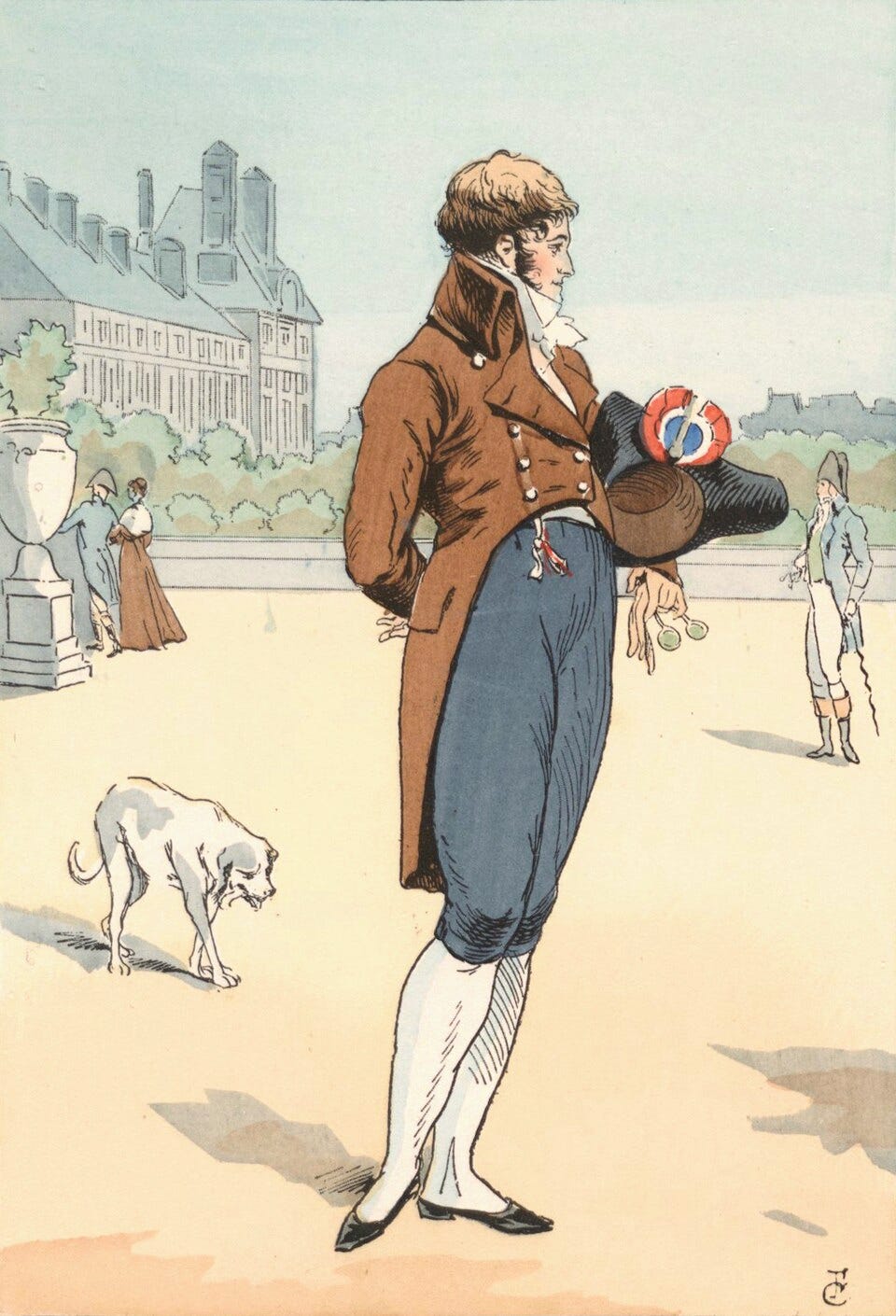
Dominic Green reviews a new history of the dandy: “Some gentlemen are dandies, but most dandies are not gentlemen. Peter K. Andersson’s The Dandy is a carefully tailored account of the dandy’s birth in Europe’s age of democratic revolutions and reactionary restorations, his trans-Atlantic triumph before 1914 and the periodic proofs of life that persist in our age of leisurewear. The dandy may have many names, but we know him when we see him—he projects the aristocrat’s ‘superior air and nonchalant ennui,’ Mr. Andersson writes, only a little too much. Divided by competing urges to ‘join in and stand out,’ the dandy exaggerates style to the point of satire and social impertinence.”
Poem: Carla Galdo, “Snowdrops”

