
Queering Plastic Pollution
Also: At Alice Walton’s art museum in Arkansas, the return of the Washington Star, the decline of reading, the growth of bookstores, and more.

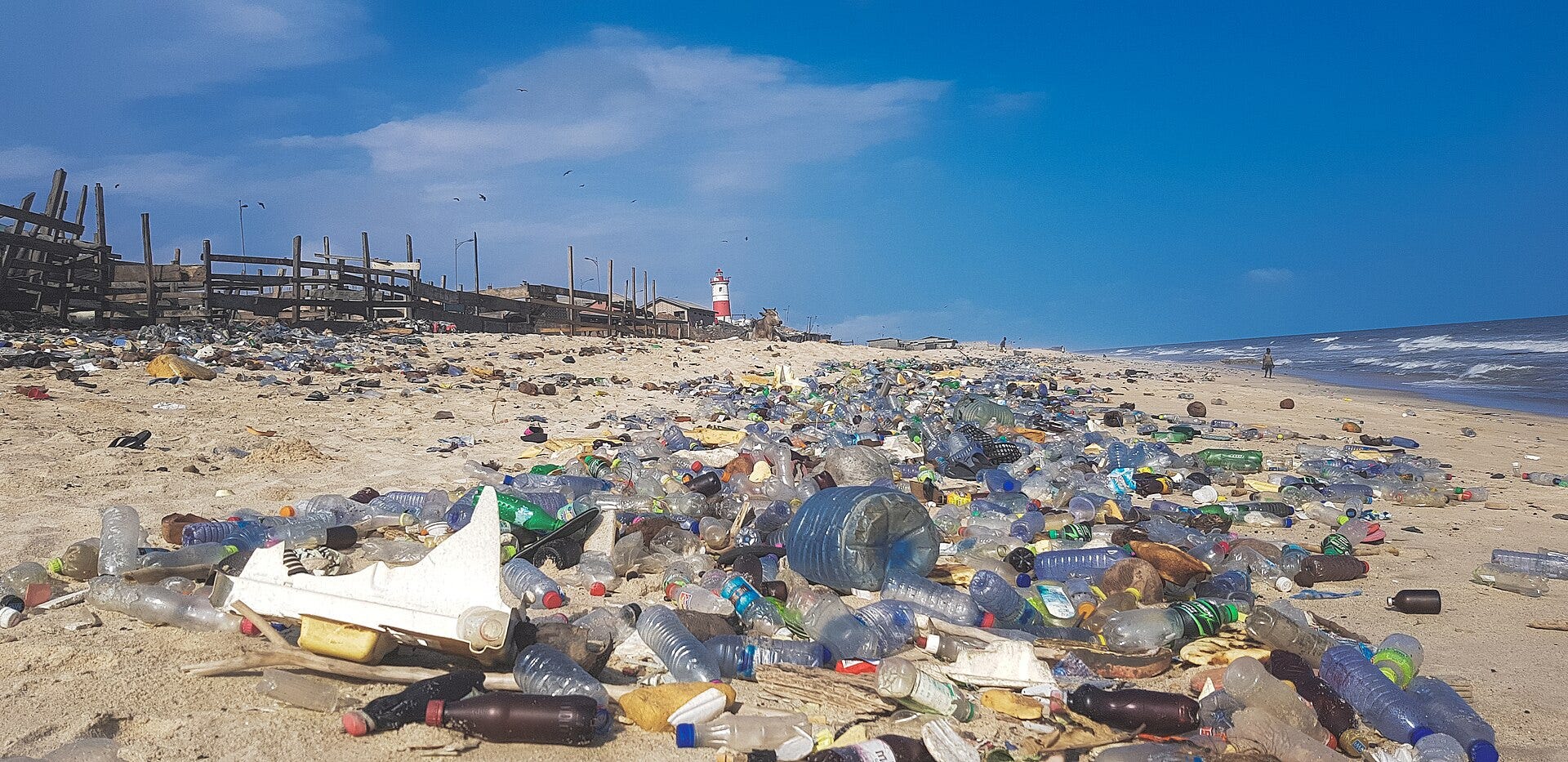
Good morning! In the latest issue of the Hedgehog Review, Geoff Shullenberger writes about critical theory’s longstanding anti-humanism that has given us things like queering plastic pollution, where theorists welcome pollutants that kill us (or, as one writer put it, that promise a “nonreproductive futurity”). What do these theorists make of AI, which promises to kill the author—and the critic—for good?
There is one burgeoning academic subfield that, perhaps surprisingly, has yet to attract the ire of anti-woke crusaders. This area of scholarship is new enough that it doesn’t have a name yet, but I will call it Queer Chemical Studies (QCS). QCS begins by noting a phenomenon widely decried by environmental activists and studied by biologists, ecologists, and medical researchers: the impact of plastics, pesticides, and other synthetic materials in the environment on reproduction, human and animal. It then makes the classic critical-jujitsu move of questioning the binary of natural/unnatural underlying the usual responses to this fact. When environmentalists worry about endocrine disruption, QCS scholar Giovanna Di Chiro alleges, they are reinforcing “eco(hetero)normativity,” which assumes the necessity of heterosexual reproductivity.
QCS scholars instead invite us, as New School professor Heather Davis puts it in her 2022 book Plastic Matter, to view “the queering of the body” brought about by environmental toxins “as opening on to new, and ecological, possibilities rather than reasserting a threatened heteronormative configuration.” The remarkable implication of this is that pervasive pollution can be recast as a vector of queer liberation.
More:
The QCS discovery that queer liberation is being realized by the petrochemical industry may seem like a niche matter, but it is emblematic of a broader impasse faced by the academic humanities. For the past half century, humanists have deconstructed, subverted, problematized, and queered every normativity and supremacy they could find. The ultimate target of this systematic critical project was, paradoxically, the value that originally founded and gave shape to their disciplines: humanism. The dismantling of “Man” was the impetus for some of the founding polemical statements of what came to be called “theory.” In recent decades, this project was reinvigorated in the form of “posthumanism” and the “posthumanities,” which launched an attack on the most centric of all centrisms: anthropocentrism. In line with this project, QCS discards any idea of a fixed, natural human essence to which synthetic substances pose a threat.
In other news, Nate Freeman goes to Alice Walton’s art museum—Crystal Bridges—in Bentonville. The Clintons are there. So is Sarah Huckabee, Martha Stewart, Jewel, and Arianna Huffington:
“It says a lot that you are all here,” said Olivia Walton, Alice’s daughter-in-law, the board chair of Crystal Bridges, who will spearhead the museum into the future. She was looking down at the former president who once ran Arkansas, and the current Arkansas governor, whose father also once served as governor of the state. “It’s the proof point of the power of art to bring us together,” she said.
They call it America’s Art Museum. It’s on the walls, it’s on the totebags. It is certainly the greatest art museum not in one of our major cities but firmly in America—it’s smack-dab in the middle of the country, a few hours drive from the geographic centerpoint of the continental states. But considering what’s happening in Washington, with the Smithsonian, it’s no stretch to go to Bentonville, see what’s happening at Crystal Bridges, and think: This is the future of American art museums.
The key to all of it is Alice Walton. Yes, she’s the richest woman in the world, worth about $139 billion. She can buy whatever art she wants. As a museum director in attendance told me, marveling at another one of the new buildings on campus: This is what hundreds of billions of dollars will get you, the literal best of anything. But the totality of Crystal Bridges, the effect these specific artworks can have on a person, the gigantic task of corralling culture to the middle of the Ozarks—it can’t just be chalked up to an unlimited budget. It has to be fueled by an authentic passion for art.
And that’s all Walton, a relentless art collector. After spending decades buying works by American masters from the 19th and 20th century, Walton set her focus on contemporary US artists—and assembled another unimpeachable trove. Anecdotally, from talking to her peers an echelon below her, she’s the patron that all other aspiring collectors yearn to become. After collecting privately herself for years, she started dreaming up a museum in the late 1990s, and took the better part of a decade to plan out a massive museum infrastructure in Bentonville, still the global headquarters of Walmart. It opened in 2011, and two million people visited in the first two years. The original building was hailed as a Fitzcarraldoian achievement, an encyclopedic world-class museum on top of a creek in a town of 63,000—but given the attendance figures, it immediately needed more space.
More:
Walking around the Bentonville campus, you may ask yourself: How did all of this get here? Bike around . . . and you’ll see a Louise Bourgeois Maman spider-like sculpture rise up above the tree line, 33 feet tall. That hut that you can bike up to? It’s a James Turrell. There’s a Frank Lloyd Wright house that I caught at the right time: completely empty, allowing for a transcendent quiet moment with heartbreaking modern architecture. Venture around town and you’ll find that, despite it being home to the headquarters of America’s largest retailer and the billionaires that control it, it lacks the Aspen vibe of fancy boutiques and Sant Ambroeus and the like. Thank God for that. Instead there’s a Walmart Museum in the middle of downtown with a recreation of Sam Walton’s office, and all of his baseball caps. Some choice picks among them: “Grand National Quail Club, Enid Oklahoma” and “Wal-Mart Shareholders’ Meeting ’88.” And it’s a short walk from the real Walmart, where everybody actually shops.
The author of Hamnet, Maggie O’Farrell, has a new novel: Land. Kazuo Robinson reviews it in Harvard Review and is not impressed: “The writing is not good enough even to satisfy our ears. Descriptions are allowed to go long in the hope that they will be made more vivid by the present tense, but they are often generic. The hold of a passenger ship is ‘filled with jostling bodies and people calling to each other, pushing this way and that.’ We will be disappointed as we continue if we hope for more specific detail: ‘There were packages and luggage stacked in passageways, bottles lashed together, doors opening and closing, sailors rushing, passengers arguing and shoving.’ O’Farrell has not quite been able to picture the scene and has needed to return to the pushing, or shoving. As in much historical fiction, language is a general issue because full historical immersion is unachievable or undesirable, and the compromise involves archaic and slightly formal, stiff vocabulary and phraseology. Things don’t happen to people in Land, they ‘befall’ them, and when someone has learned something, we are told that they ‘attained the awareness.’ Rather than say yes, a character might prefer ‘exactly so’ to keep up old timey appearances.”

