
Monday Links
The problem with contemporary publishing, Lionel Shriver’s new novel, the works of Leonardo Sciascia, in praise of Richard F. Burton, a “magnificent” book on sacrifice, and more.

Good morning! Has new media killed reading? Adam Mastroianni doesn’t think so:
The hot new theory online is that reading is kaput, and therefore civilization is too. The rise of hyper-addictive digital technologies has shattered our attention spans and extinguished our taste for text. Books are disappearing from our culture, and so are our capacities for complex and rational thought. We are careening toward a post-literate society, where myth, intuition, and emotion replace logic, evidence, and science. Nobody needs to bomb us back to the Stone Age; we have decided to walk there ourselves.
I am skeptical of this thesis. As a psychologist, I used to study claims like these for a living, so I know that the mind is primed to believe narratives of decline. We have a much lower standard of evidence for “bad thing go up” than we do for “bad thing go down.”
Unsurprisingly, then, stories about the end of reading tend to leave out some inconvenient data points. For example, book sales were higher in 2025 than they were in 2019, and only a bit below their high point in the pandemic.
Independent bookstores are booming, not busting; at least 422 new indie shops opened in the United States last year alone. Even Barnes & Noble is cool again.
The actual data on reading, meanwhile, isn’t as apocalyptic as the headlines imply.
Richard Beard argues that both generative AI and university creative writing programs treat writing as a formula—and wrongly so:
Turing’s Imitation Game paper was published 14 years after the first Writers’ Workshop convened at the University of Iowa, in 1936. Turing may not have known, with his grounding in maths at King’s College Cambridge, that elements of machine learning had already evolved across the Atlantic in the apparently unrelated field of creative writing. Before Iowa, the Muse; after Iowa, a method for assembling literary content not dissimilar to the functioning of today’s LLMs.
First, work out what effective writing looks like. Then, develop a process that walks aspiring writers towards an imitation of the desired output. The premise extensively tested by Iowa – and every creative writing MFA since – is that a suite of learnable rules can generate text that, as a bare minimum, resembles passable literary product. Rare is the promising screenwriter unfamiliar with Syd Field’s Three-Act Structure or Christopher Vogler’s Hero’s Journey: cheat codes that promise the optimal sequence for acts, scenes, drama and dialogue. In the same way that an LLM is designed to ‘think’, these templates are a form of reverse engineering: first study how the mechanics of Jaws or Witness made those movies sing, then identify transferable components for reassembly to achieve similar artistic success further down the line.
To a computer-programmer, reverse engineering as a machine-learning mechanism is known as back-propagation. In A Brief History of Intelligence (2023), Max S Bennett shows how this methodology has already helped in the development of image recognition, natural language processing, speech recognition, and self-driving cars. Supervising coders work to isolate the required answer in advance, then go back to nudge input responses until the artificial neural network arrives at the pre-set solution.
If only writing were so simple. According to figures from Data USA, up to 4,000 students graduate each year with creative writing MFAs in the US. No one expects that number of Great American Novels to show for so much studying, despite the fact that many hopeful writing careers start with the prompt mentality invited by Chat GPT: I want to write a bestseller like the one that blew me away last summer. Or, for the more adventurous: something new but relatable, a novel/memoir hybrid with literary credibility and strong narrative momentum, like a cross between Lee Child and Annie Ernaux. Thank you. I’ll wait. But not very patiently.
Daniel Akst reviews Adam Szetela’s That Book Is Dangerous! How Moral Panic, Social Media, and the Culture Wars Are Remaking Publishing. The book was published this summer, but I somehow missed it:
Barney Rosset risked violence and insolvency so that his Grove Press could print unexpurgated American editions of such forbidden works as Lady Chatterley’s Lover in 1959 and Tropic of Cancer in 1961. To publish Ulysses in 1934 without risking prosecution, Random House first had to orchestrate a court case to prove the book innocent of obscenity.
Today’s publishers aren’t much constrained by obscenity laws. Instead, the pressure comes from staff members and social-media mobs wielding their “militant fragility,” in the words of Adam Szetela, to remake our book culture into an anodyne enterprise that puts “safety” first. Mr. Szetela lays bare this remarkable phenomenon in That Book Is Dangerous! How Moral Panic, Social Media, and the Culture Wars Are Remaking Publishing.
The result is a devastating work of scholarship that commits the ultimate transgression of failing to include the trigger warnings so cherished by the targets of the author’s indictment. Readers might well feel they deserve a warning too, for sane lovers of literature who read this book are likely to experience fury and even despair by the time they finish.
Pamela Paul talks to Lionel Shriver about her forthcoming novel:
The latest novel by Lionel Shriver, literary darling turned literary-world scourge, doesn’t come out until mid-February, and it’s already polarizing. “Her worst book, by a wide margin,” according to an early review of A Better Life in Kirkus, a trade journal. “It’s a mess,” agreed Publishers Weekly. Meanwhile, a starred review in Library Journal praised its “deft prose” noting, “This is a book readers will be eager to talk about.”
Of that, there is little doubt. Not only is Shriver herself a lightning rod, but A Better Life is a novel about a torpedo of an issue: immigration. And it’s landing at a fevered moment when the enforcement of immigration law under President Trump and the deaths of Renee Good and Alex Pretti in Minneapolis have gripped and divided the nation.
The story imagines the implementation of what was an actual abandoned proposal by former mayor Eric Adams to house migrants in New Yorkers’ homes, and a fictional progressive Brooklyn family that signs up with gusto but gets mugged by reality.
“This is a story about a family having their home invaded and taken over physically, which is obviously a metaphor,” Shriver told me when I interviewed her in her home in Windsor Terrace, Brooklyn, a precinct well up in arms over immigration policy. (An anti-ICE poster features prominently in her neighbor’s window.)
In her columns for The Spectator, Shriver has railed against open immigration and denounced asylum. But in her novel, rather than satirize or steamroll, Shriver takes her open-armed and open-borders characters as seriously and empathetically as her anti-immigration ones. Gloria Bonaventura, the novel’s matriarch, makes an impassioned plea for housing an immigrant in terms one might easily overhear on the checkout line at the Park Slope Food Coop: Migrants are endangered, resourceful, brave, and a boon to the economy. They are eager to become American citizens. The motivations and values of its central Honduran character, Martine, are tantalizingly elusive. She may be a conniving opportunist; she may be an abused and desperate woman simply hoping for a better life.
“It’s more interesting to write about something I’m torn about,” Shriver told me. “I’m conflicted about immigration, because I do see the other side.” A Better Life, she said, is “perfectly balanced – even more so than I intended.”
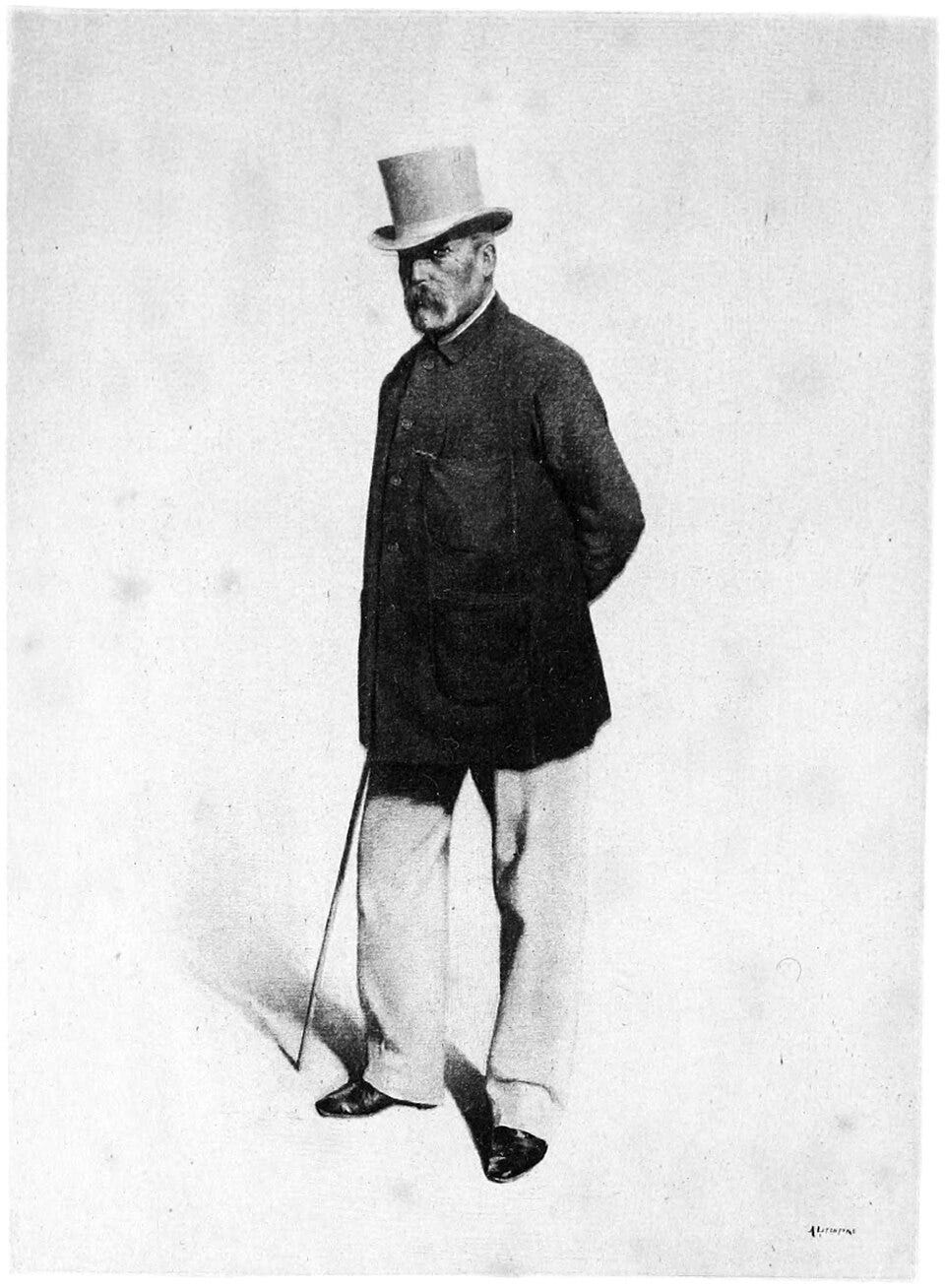
Jude Russo writes about the adventurer Richard F. Burton in The Lamp. Excuse the long excerpt here, but one or two paragraphs does not do the piece—or Richard Burton—justice:
You want explorers? Here is the godfather of them all. Richard Francis Burton was born in 1821 to an Anglo-Irish officer in the British Army. Lieutenant Colonel Joseph Burton was something of an eccentric, moving his family around England and continental Europe, where the young Burton picked up bad habits and a number of foreign languages. After a varied secondary education, he came to Oxford with ambitions of becoming a linguist.
“My reception at College was not pleasant,” wrote Burton in a passage quoted by Thomas Wright, his biographer. “I had grown a splendid moustache, which was the envy of all the boys abroad, and which all the advice of Drs. Ogle and Greenhill failed to make me remove. I declined to be shaved until formal orders were issued by the authorities of the college. For I had already formed strong ideas upon the Shaven Age of England, when her history, with some brilliant exceptions, such as Marlborough, Wellington and Nelson, was at its meanest.”
Unlike the mustache, Oxford did not grow on Burton. The feeling was mutual. His behavior was generally bad, and in 1842 he was sent down for attending a forbidden horse race.
Naturally, Burton’s next step was to get a commission in the Bombay Army and try to serve in the First Anglo-Afghan War. The war was over by the time he stepped off the ship, but British India was still there in all the chaotic glory of the last years of Company Raj. In his seven years in the Bombay Army, he became proficient in a variety of Indian languages, as well as Persian and the Arabic he had started at Oxford.
It was in 1853 that Burton undertook his first really great feat. Having obtained leave from the army and after taking on a series of elaborate and frankly outrageous disguises, he performed the hajj. While the journey was made under the auspices of the Royal Geographical Society to improve knowledge of the Arabian peninsula, the same naughty schoolboy attitude that earned expulsion at Oxford permeates his account of the journey: “What remained for me but to prove, by trial, that what might be perilous to other travellers was safe to me? . . . Being liberally supplied with the means of travel by the Royal Geographical Society; thoroughly tired of ‘progress’ and of ‘civilisation;’ curious to see with my eyes what others are content to ‘hear with ears,’ namely, Moslem inner life in a really Mohammedan country; and longing, if truth be told, to set foot on that mysterious spot which no vacation tourist has yet described, measured, sketched and photographed, I resolved to resume my old character of a Persian wanderer, a ‘Darwaysh,’ and to make the attempt.”
B. D. McClay continues her series on speculative fiction in The Point:
“Mother of Cloth, Heart of Clock” is a short story in the form of a monologue. Its narrator is a lab animal, but also a circus performer. What sort of animal it is we never really learn, but given the details—it can climb, hold things in its arms, be petted, do tricks and dismember an adult man—it’s probably some kind of primate. The title, with its reference to Harry Harlow’s experiments on rhesus monkeys, also points in this direction, so in honor of those unfortunate animals, and for the sake of simplicity, we’ll call it a monkey. What the point of this half-circus, half-laboratory setting could possibly be we also never learn. How could we? Nobody ever bothers explaining it to our narrator, and his viewpoint is the only one we have.
Our monkey has killed a man. It tells us that the death was intentional—“I meant to kill him but I had no idea I could do it so completely”—though later it’ll say it didn’t mean to. It’s in a cell with the bloody straw that death left behind, and it wishes it weren’t. It misses its friends, Flippy and Jumpo. It misses its old lover, Nappi, who was taken away to the lab and came back wrong. It misses its old keeper, Braddock, who is also the person it killed, his body “partly ingested, the stomach torn out like the sawdust stuffings of a wooden doll.” The monkey’s life has been a whole series of missings, ever since it lost its mother.

