Fall Books
Also: N.A.M. Rodger’s “majestic” naval history, the life and work of Elmore Leonard, the stories of Robert Louis Stevenson, and more.

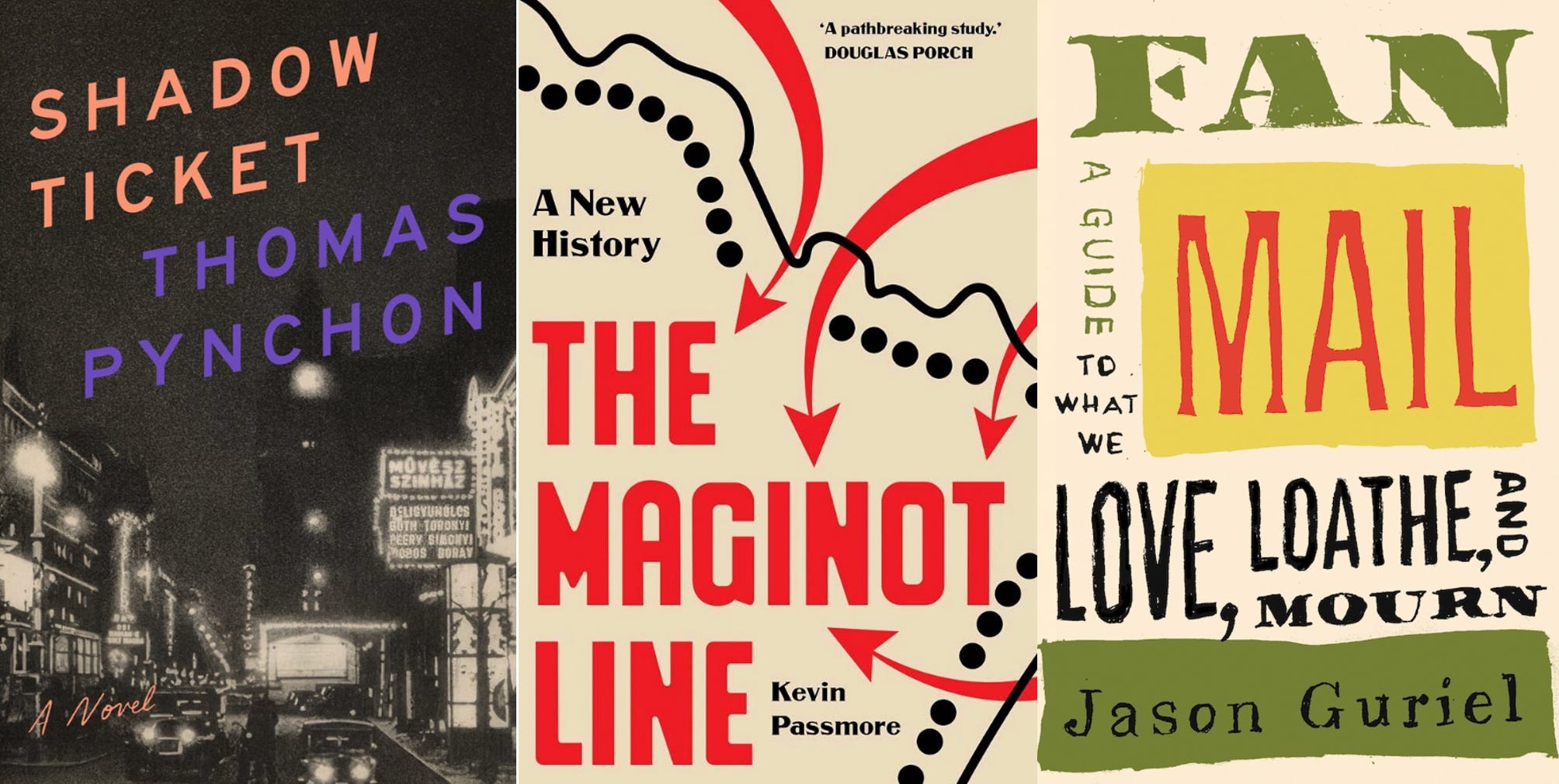
Town and Country’s list of “49 must-read books of fall 2025” reminded me it was time to make my own list. Unlike Town and Country—or Time or Oprah—I don’t pretend that the books I list below are “must-reads” or even the best books of the fall. I haven’t read most of them yet, so I don’t know how good (or bad) they might be. Some of them may turn out to be terrible. They are simply books that look interesting to me.
Thomas Pynchon’s new novel (October 7) is on everyone’s list, and it is on mine, too. His previous novel, Bleeding Edge, about September 11, was published 12 years ago. Michael Dirda called it “totally gonzo, totally wonderful.” In Shadow Ticket, Pynchon revisits the 1930s:
Milwaukee 1932, the Great Depression going full blast, repeal of Prohibition just around the corner, Al Capone in the federal pen, the private investigation business shifting from labor-management relations to the more domestic kind. Hicks McTaggart, a onetime strikebreaker turned private eye, thinks he’s found job security until he gets sent out on what should be a routine case, locating and bringing back the heiress of a Wisconsin cheese fortune who’s taken a mind to go wandering. Before he knows it, he’s been shanghaied onto a transoceanic liner, ending up eventually in Hungary where there’s no shoreline, a language from some other planet, and enough pastry to see any cop well into retirement—and of course no sign of the runaway heiress he’s supposed to be chasing. By the time Hicks catches up with her he will find himself also entangled with Nazis, Soviet agents, British counterspies, swing musicians, practitioners of the paranormal, outlaw motorcyclists, and the troubles that come with each of them, none of which Hicks is qualified, forget about being paid, to deal with. Surrounded by history he has no grasp on and can’t see his way around in or out of, the only bright side for Hicks is it’s the dawn of the Big Band Era and as it happens he’s a pretty good dancer. Whether this will be enough to allow him somehow to Lindy-hop his way back again to Milwaukee and the normal world, which may no longer exist, is another question.
Very Pynchon.
A lot of novels did not make this list. I am not interested in Patricia Lockwood’s new novel Will There Ever Be Another You (September 23). Nor am I interested in pretty much anything Dan Brown writes, including his new novel, The Secret of Secrets (September 9). Angela Flournoy’s The Wilderness (September 16) and Souvankham Thammavongsa’s Pick a Color (September 30) were both featured on several lists I have read. Not this one.
But I am interested in Michael Connelly’s Proving Ground (October 21), John Banville’s Venetian Vespers (October 7), David McCloskey’s The Persian (September 30), Kiran Desai’s The Loneliness of Sonia and Sunny (September 23) and Salman Rushdie’s collection of shorter work, The Eleventh Hour (November 4). This newsletter’s fiction columnist, John Wilson, has written about both Connelly and McCloskey. Check out John’s columns here.
Other books that look interesting in September include: Matthew Bell’s Goethe: A Life in Ideas (September 9), Fergus Butler-Gallie’s Twelve Churches: An Unlikely History of the Buildings That Made Christianity (September 9) (which I am reading now), Marcus Willaschek’s Kant: A Revolution in Thinking (September 16), Lydia Davis’s Into the Weeds (September 16), Frances Wilson’s Electric Spark: The Enigma of Dame Muriel (September 23), Sunil Iyengar’s Colosseum Book of Contemporary Narrative Verse (September 26), Christopher C. Gorham’s Matisse at War (September 30), and Roger Lewis’s The Life and Death of Peter Sellers (September 30).
In October, we have:
Three early stories by Virginia Woolf (October 7): “In 1907, eight years before she published her first novel, a twenty-five-year-old Virginia Woolf drafted three interconnected comic stories chronicling the adventures of a giantess named Violet--a teasing tribute to Woolf's friend Mary Violet Dickinson. But it was only in 2022 that Woolf scholar Urmila Seshagiri discovered a final, revised typescript of the stories. The typescript revealed that Woolf had finished this mock-biography, making it her first fully realized literary experiment and a work that anticipates her later masterpieces. Published here for the first time in its final form, The Life of Violet blends fantasy, fairy tale, and satire as it transports readers into a magical world where the heroine triumphs over sea-monsters as well as stifling social traditions.”
Edward J. Watts’s new history of the Roman Empire (October 7): “When we think of “ancient Romans” today, many picture the toga-clad figures of Cicero and Caesar, presiding over a republic, and then an empire, before seeing their world collapse at the hands of barbarians in the fifth century AD. The Romans does away with this narrow vision by offering the first comprehensive account of ancient Rome over the course of two millennia. Prize-winning historian Edward J. Watts recounts the full sweep of Rome’s epic past: the Punic Wars, the fall of the republic, the coming of Christianity, Alaric’s sack of Rome, the rise of Islam, the Battle of Manzikert, and the onslaught of the Crusaders who would bring about the empire’s end. Watts shows that the source of Rome’s enduring strength was the diverse range of people who all called themselves Romans.” Its military may have also had something to do with its “enduring strength.”
Jenny Erpenbeck’s Things That Disappear (October 7): “The bestselling and award-winning German author Jenny Erpenbeck has gained international praise for her novels including Visitation, Kairos, and Go, Went, Gone. Things that Disappear is an exciting collection of interlinked miniature prose pieces that grapple with the phenomenon of disappearance on scales both large and small. The things that disappear in these pages range from everyday objects such as socks and cheese to close friends and the social norms of common courtesy, to sites and objects resonant with East German history, such as the Palace of the Republic or the lines of sight now blocked by new construction in Berlin. Erpenbeck asks: "Is there some kind of perpetrator who makes things that I know cherish and disappear?" These things disappear, and yet do they really? Do they remain in our memories more fully than if they continued to exist?”
Kevin Passmore’s new history of The Maginot Line (October 14): “The Maginot Line was a marvel of 1930s engineering. The huge forts, up to eighty meters underground, contained hospitals, modern kitchens, telephone exchanges, and even electric trains. Kilometres of underground galleries led to casements hidden in the terrain, and turrets that rose from the ground to fire upon the enemy. The fortifications were invulnerable to the heaviest artillery and to chemical warfare. Despite this extensive preparation, France fell to Germany in a little under six weeks. Eight decades on, the Maginot Line is still remembered as an expensively misguided response to obvious danger.”
James Schiff’s selection of John Updike’s letters (October 21). From the jacket: “The arc of literary giant John Updike’s life emerges in these luminous daily letters to family, friends, editors, and lovers—a remarkable outpouring over six decades, from his earliest consciousness as a writer to his final days.”
Morten Høi Jensen’s study of Thomas Mann’s Magic Mountain (October 21): “ This poignant book is a biography of Mann's great novel--its evolution from a short story into a two-volume masterpiece and one of the bestselling novels of the Weimar era. Deftly weaving together elements of biography, history, and literary criticism, Morten Høi Jensen reveals how writing The Magic Mountain against a backdrop of world war, revolution, hyperinflation, and rising right-wing terror moved Mann to embrace the democratic and humanistic ideas he once scorned.” Did Mann “embrace the democratic and humanistic ideas he once scorned”? Aye, there’s the rub.
Jason Guriel’s Fan Mail: A Guide to What We Love, Loathe, and Mourn (October 23): “Jason Guriel’s Fan Mail: A Guide to What We Love, Loathe, and Mourn is a book about fandom in all its obsessive, contradictory, and deeply personal forms. But more than that, it’s an inquiry into how love for art—books, music, movies, poetry, comics—shapes not just our tastes but our lives. Guriel, an acclaimed poet and critic, assembles a series of essays that trace his own experiences as a fan, while simultaneously constructing a larger meditation on what it means to be enthralled by culture.”
Angie Hobbs’s book on Why Plato Matters Now (October 28): “Exploring the intersection between the ancient and the modern, Professor Hobbs shows how Plato can help us address key questions concerning the nature of a flourishing life and community, healthcare, love and friendship, heroism, reality, art and myth-making. She also shows us how Plato's adaptation of the Socratic method and dialogue form can enable us to deal with contested issues more constructively.”
Bill Hardwig’s study of Cormac McCarthy’s style (October 29): “While it is McCarthy’s grim depiction of violence and his texts' complex philosophical perspectives that receive the most attention from scholars, readers who admire the author’s work are often drawn to it initially, as Bill Hardwig was, at the level of language, attracted by the breathtakingly original way McCarthy strings together words and paints images in the minds of readers. In How Cormac Works, Hardwig suggests that McCarthy’s defining attribute as an author falls not in the realm of psychology, philosophy, or history but in his experimentation with language--in the style that gives his books their atmosphere, mood, and tone.”
And Francesca Wade’s biography of Gertrude Stein. It seems overhyped. According to the jacket copy, it presents “this towering literary figure as we’ve never seen her before.” Stein was not a “towering literary figure.” Still, I am interested in Stein’s salon and her interactions with other artists and what supposedly “never-before-seen interviews” with Stein tell us about her life and work and the life and work of artists of the period.
Books with a November release that caught my eye include:
The first book of Node Four in Aleksandr Solzhenitsyn’s nearly unending Red Wheel cycle (November 1): “April 1917, Book 1, captures the division and helplessness of Russia's first Revolutionary rulers, paving the way for the victory of the ruthless Bolsheviks later that year.”
Gerald Howard’s biography of Malcolm Cowley (November 4): “Malcolm Cowley is not a household name today, but the American literary canon would look very different without him. A prototypical “man of letters” of his generation—Harvard University, a volunteer in the French ambulance corps in World War I, a rite of passage in Paris after the war—he became one of the few truly influential critics of the 1920s and ’30s, along with his close New Republic colleague Edmund Wilson. Cowley’s early support of Hemingway, Fitzgerald, and their set—and indeed for framing this group in generational terms in the first place—secured his place in literary history.”
Leslie Baynes’s Between Interpretation and Imagination: C. S. Lewis and the Bible (November 4): “In this highly original study, New Testament scholar Leslie Baynes illuminates C. S. Lewis’s writing on the Bible. She reveals never-before-published notes, written by Lewis in books that he owned, that offer unique insight into his thinking on Scripture, and she identifies the figures who shaped his approach to biblical interpretation: Charles Gore, James Moffatt, Sister Penelope Lawson, George MacDonald, Austin Farrer, and more.”
Daniel Swift’s The Dream Factory: London’s First Playhouse and the Making of William Shakespeare (November 11): “How Shakespeare became Shakespeare: a riveting tale of London’s first playhouse and the people―actors, writers, builders, investors―who built the Theatre.”
And T.P. Wiseman’s The Lost History of Roman Theatre (November 25): “Theatre was an integral part of Roman civic, religious and political life for nearly a thousand years, but our understanding of it is skewed by the haphazard survival of usable evidence. The widely accepted date for the beginning of Roman drama is 240 BC, but that is only the date of the first known dramatic works. Theatre as a public spectacle was created in Athens and in Greek Sicily at the end of the sixth century BC, when the culture of Rome, to judge by the archaeological evidence, was itself thoroughly Greek. There is therefore no need to imagine that the Romans knew nothing of drama until centuries after its inception. In The Lost History of Roman Theatre, the distinguished classics scholar T. P. Wiseman reexamines the often-obscured origins of Roman theatre.”
In other news, Paul Kennedy reviews N.A.M. Rodger’s The Price of Victory: A Naval History of Britain: 1815-1945: “Every so often a work of history comes along so substantial in its sheer size, so erudite in its scholarship and so well achieved that it makes others seem minor by comparison. So the appearance of The Price of Victory, the third and final volume in N.A.M. Rodger’s massive naval history of Britain, is worth special attention—and not only to readers interested in maritime affairs. For what Mr. Rodger has done here is to use the lens of Britain’s naval story, from Anglo-Saxon times to the close of World War II, to offer a majestic, confidently written sweep of historical scholarship. There is really nothing quite like it, or that comes close to it, in any recent work of military or naval history.”
Victorino Matus reviews James Holland’s Cassino ’44: The Brutal Battle for Rome: “Until recently, my understanding of the battle for Italy from 1943-44 was straightforward: After landing in Sicily, U.S. and British forces hopped across to Salerno, then Anzio, working their way up the boot until they reached Rome. I hadn’t given much thought about the terrain, the logistics of a multinational force that included New Zealanders, Poles, Moroccans, and Indians, not to mention the miserable weather and the strategic errors that cost countless lives. This lack of appreciation was a concern even at the time. In a letter to his family, Lawrence Franklyn-Vaile of the 38th Irish Brigade wrote in part, ‘There is also a strong feeling that the Second Front is being so glamourised that, when it does commence, people will forget all about this campaign and will be saying afterwards, “What, were you not in the Second Front, oh Italy, that was nothing.”’ It was not nothing, and historian James Holland has not forgotten it.”
The life and work of Dorothy Parker:
Parker was fired from Condé Nast in 1920, after some of Broadway’s biggest producers (all regular advertisers) complained about her constant savaging of their plays, and of Florenz Ziegfeld’s wife. She continued as a drama critic at Ainslee’s for another three years and then, in 1927, spent twelve months as ‘Constant Reader’, writing about books for the New Yorker and accruing what the magazine’s founding editor, Harold Ross, described as a ‘mountain of indebtedness’. ‘Her Constant Reader,’ he insisted, ‘did more than anything to put the magazine on its feet, or its ear, or wherever it is today.’
Parker approached books in the same way as she had plays. That is, she tended to dodge analysis of works she admired: ‘What more are you going to say of a great thing [in this case, Ring Lardner’s collected stories] than that it is great?’ Instead, she preferred what Sloane Crosley calls the ‘low-hanging fruit’ of Elinor Glyn, Emily Post and Winnie the Pooh, at whose insistent whimsy ‘Tonstant Weader Fwowed Up’. The main draw was always Parker herself. Never mind the book, what readers wanted to know was that she’d hurled it across the room or assessed it as ‘second only to rubber duck’ as a ‘bathtub companion’. ‘And if it slips down the drainpipe, all right, it slips down the drainpipe.’ And how could she be expected to finish Mussolini’s The Cardinal’s Mistress (‘the Lord knows I tried’) or Forty Thousand Sublime and Beautiful Thoughts (‘conscientious though I be, I am but flesh and blood’)? When Dwight Macdonald identified ‘amiability’ as the distinctive quality of New Yorker criticism, he wasn’t thinking of Parker.
Andrew Motion revisits the work of Robert Louis Stevenson: “The bare bones of Stevenson’s story are by now familiar to anyone with even a passing interest in him. He was born in Edinburgh in 1850, the sickly child of a famous lighthouse-building family, whose father, Thomas, was both leniently supportive of his son (he saved him from financial ruin on numerous occasions) and also a goad to his conscience: how could a life spent writing not seem inferior to the sheer hard work of building lighthouses around Scotland’s famously rugged coast? Furthermore, how could an irreligious son keep a God-fearing father’s respect? These tensions inevitably produced conflicts, but they also provided Stevenson with recurring structures in his fiction, where parent-child relationships (whether they be within an actual family, or between an older person and a younger Jim and Long John Silver, for instance) are always placed front and centre.”
Christopher Scalia reviews a new book on the life and work of Elmore Leonard: “When Elmore Leonard died in 2013, he was the undisputed king of crime fiction. Writers and celebrities like Walker Percy, Nora Ephron, Clint Eastwood, Donald Fagen, Stephen King, Martin Amis, Ann Beattie, and George F. Will celebrated his novels. His best-selling novels—full of double-crosses, dirty-dealing, uptight stooges, smooth antiheroes, plot twists, and deadpan dialogue—inspired some of the coolest shows and films of the past 30 years. Indeed, cool is the quality most commonly attributed to Leonard. C.M. Kushins knew that when he called his new biography, timed to commemorate the centennial of the novelist's birth, Cooler Than Cool . . . But as Kushins’s biography makes clear, Leonard's own coolness didn't come easy. The man worked his tail off.”
In praise of solitude: “In 2023, the Office of the Surgeon General declared that the United States is enduring an ‘epidemic of loneliness and isolation.’ Even before the COVID-19 pandemic, approximately half of U.S. adults reported experiencing loneliness . . . Overwhelmingly, friendship and group activities are touted as the solution to the crisis. We must socialize ourselves out of this epidemic, we’re told. We are admonished to get our bottoms off the couch and our eyes off our phones, to host potlucks and parties, start book clubs, go to church, make small talk, volunteer, and attend public forums. At a seminar I recently organized on “solo aging,” the enthusiastic facilitator, herself a proud solo ager, concluded the program with her best advice: ‘Get out there! Don’t be shy! Say “yes”!’ Kate Leaver’s The Friendship Cure urges people to put more effort into making and keeping friends as the key to remedying the loneliness epidemic . . . The assumption that solitude is the antithesis of sociality underwrites journalist Derek Thompson’s January 2025 cover story for The Atlantic, which pronounces ours an ‘anti-social century’ . . . But a fuller, more generous conception of solitude shows that it can serve as the foundation of community, not its foil.”