
Against Optimization
Also: Dr. Death’s passion for Handel’s “Messiah,” the life and work of Alexandre Kojève, a history of fairies, Oxford’s new humanities center, and more.


Good morning! This edition of Prufrock is a day late, but better late than never, as the saying goes—at least, I hope that’s the sentiment!
In the Point, Nicholas Clairmont writes about “optimization” and why he dislikes it:
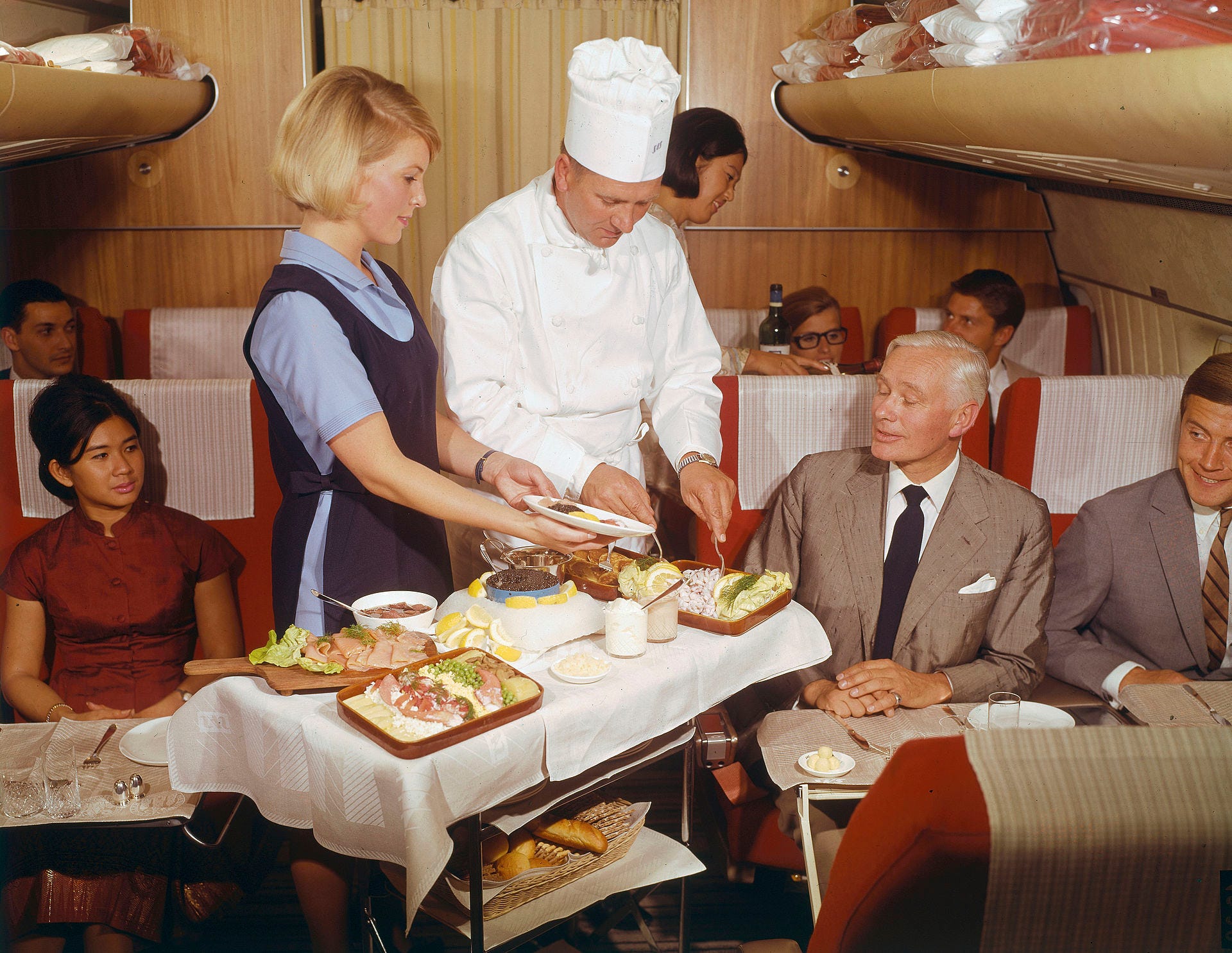
“Le mieux est l’ennemi du bien,” wrote Voltaire, usually translated to “the perfect is the enemy of the good,” and more often rendered in the imperative as “don’t let the perfect be the enemy of the good.” The quote rang in my head recently while on a journalistic junket that had me flying business class to Dubai, which is not how or where I usually fly. We hit some turbulence somewhere over Europe while I passed through the Emirates A380’s spacious bar area on the way to take a piss, so I was asked sternly by the bartender to sit down and buckle up on the couch along with two other guys until the plane stopped bucking, trapped in a modern technological miracle of luxury as well as an awkward social situation. One of them was a sinister-looking, Russian-accented guy with the affect of a businessman or politician. He actually turned out to be really nice. The other was a chubby, underemployed thirtysomething hipster from New York, like me. He wore fine robin’s-egg-blue linen shorts, a matching button-down linen top and designer sneakers. He cut into the conversation I was having with my new friend about my incredulity that I could have a nonalcoholic gin and tonic made for me at 600 mph in an open bar in the sky to ask if we were sitting in business or first. Business, he scoffed? He told us he no longer thinks of business as anything but a sort of inconvenience, even a torture. The sleep is poor. The cabins are so rarely updated. He only flies first.
I asked him what takes him abroad. He looked at me like I was stupid. He had just told me: Flying First Class. He explained that he would be spending three nights in Dubai at a favorite hotel, part of a chain where he has status with the loyalty scheme, before carrying on with his first-class trip to the Maldives. If he departed any sooner, he’d have to fly in a lower class.
He rattled off a list of places he has flown first to recently, and I thought I’d better not mention how most of them are noted sex-tourism destinations. He had booked this flight through a complex system of points “redemptions”—exchanging one credit card’s points for another airline’s loyalty-program points and then using them to book tickets on still another, partnered airline’s flights, after buying a small number more points when he was notified that a special offer became momentarily available—and obsessive checking for when the airlines “open up” the unbooked first-class cabin reservations at the last minute. He follows specialized blogs. He uses specialized software. He has all the cards, and knows just how to make the most of them. He pities the gormless normies like me who couldn’t tell you whether you should swipe your Amex Gold at the restaurant or your Chase Sapphire Reserve at the gas station. I was talking to a Points Guy.
I was so excited. I would now fix a minor but nagging issue in my life, I thought. I have always felt, you see, that I am not getting much out of my points. Though none of them is as elite as my couchmate on Emirates, I have some points guys in my life, as I am sure you do. They will mention offhandedly that some recent air travel was paid for in airline miles they accrued over a month, and then I will go check how many points it would cost me to fly my small family somewhere and find that it costs about a million points to buy decent seats in coach for three to a not particularly far-off place, and all my spending for the year has only got me a small fraction of that. 122,000, I think when I hear this kind of tale of free, lie-flat transcontinental aviation, checking my Amex app glumly. That used to mean something. I coulda been somebody.
Points Guy explained to me, after some questioning, what I have been doing wrong all these years. He said that, unless you rack up the miles by being flown around on your employer’s expense, the key to flying first class for free all the time is that, as well as making great investments of your time into understanding how credit-card company and airline company schemes work—“Using Premium Credit-Card Rewards Is Becoming a Part-Time Job,” went one recent Wall Street Journal headline—you have to not really care about where exactly you fly, and whether you fly on one day or another. You just have to care how many points it takes, and you have to spend huge reserves of your own hours and mental space worrying over how to maximize your, as he called it, “spend.” As an employed, married father, this is not really practicable for me. So I felt spared, if not from economy class, at least from the guilt over not being able to figure something out.
What I had learned was more valuable than how to get free flights. I had learned that getting free flights would involve learning how to optimize my use of credit cards and airlines and websites, and putting some amount of my limited capacity for analytic rigor to work in service of something I find fundamentally boring and unpleasant. This is what distinguishes me from Points Guy, and from the points guys in my life: optimization costs me joy.
Nic Rowan writes about Dr. Death Jack Kevorkian’s attempt to adapt Handel’s Messiah to the big screen in the latest issue of the New Atlantis:
When Jack Kevorkian set out for California in 1976, he had every intention of leaving medicine behind in Michigan. The last two decades had been ones of disappointment and defeat. He was nearly fifty, unmarried, and stalled out in his career as chief pathologist at a large hospital in Detroit. So, like many others facing midlife crises in that hangover decade, he packed up his few belongings and headed west to devote himself to art.
His idea was to adapt Handel’s Messiah for the big screen. Kevorkian knew next to nothing about filmmaking, but he loved the music passionately. For the next few years, he worked on the project — a frustrating, mentally isolated period in which his passion gradually gave way to a deeper and more consuming obsession. California changed him, and when he returned for good to his home state in 1985, he no longer thought in terms of recitatives, choruses, and arias. Death alone was on his mind.
Kevorkian soon turned his fixation into a medical crusade. He had long believed that the seriously ill should be permitted to end their lives whenever they wished. Further, he held that doctors should feel compelled to assist them, and, moreover, to assist society more broadly by using their organs for the benefit of medicine. By the late 1990s, Kevorkian had aided in the deaths of more than a hundred people and, through a series of highly public trials, become a national celebrity. His ad hoc medical practice was cut short in 1998, when he was arrested after going on 60 Minutes with a tape of himself euthanizing Thomas Youk, a middle-aged man diagnosed with ALS. By that point, however, Kevorkian had become one of the great sensations of the late twentieth century. In hindsight, we can say he was much more than a sensation. He precipitated a change in public opinion on assisted suicide: for now over a decade, the majority of Americans have considered the practice morally acceptable.
Kevorkian died in 2011. Since then, his personal and professional papers have been housed in the University of Michigan’s library system. I read through them all — every letter, medical record, annotated manuscript — over the course of a snowed-in week in Ann Arbor in February 2025. What I came to see was a man who spent his entire adult life thinking about death. He gradually worked his way to the conclusion that anyone who desires death should be permitted to access medical assistance to reach it. And, unlike most other assisted suicide advocates, he took action. His own record of his career is, like many bodies of madness, surprisingly coherent when considered on its own terms.
The doctor may have been a crank, but he was a highly charismatic crank — a prophet. It was a role he had been rehearsing for, perhaps unknowingly, those lonely years in the desert. While his Messiah ended in failure, Kevorkian’s own public ministry has been a lasting success. To understand the world he wrought, we must behold the man.
The life and work of Alexandre Kojève: “Until 2025, the name ‘Alexandre Kojève’ was a paradox. A philosopher often invoked yet rarely read – a famous enigma. For decades, Kojève’s mythical reputation rested on rumors and anecdotes orbiting his Hegel seminar of the 1930s. This year, two intellectual biographies appeared in English at once: Marco Filoni’s The Life and Thought of Alexandre Kojève and Boris Groys’ Alexandre Kojève: An Intellectual Biography. Approaching Kojève from different angles, both restore him as a thinker in his own right, not just as a source of influence for students like Jacques Lacan and Georges Bataille, who would later turn their backs on his Hegelianism.”
In praise of Oxford’s new humanities center: “Outside, it is a carefully considered stone building, slightly 1930s in feel and deliberately collegiate. Inside, you can walk through the entire building from north to south and into its magnificent, central domed space, off which the faculties are housed on three upper stories inaccessible to the public.”
Glenn C. Arbery writes about disclosure in First Things:
In his Introduction to Phenomenology, Robert Sokolowski distinguishes between the truth of correctness and the truth of disclosure. Correctness has to do with the accuracy of statements or propositions that can be proved or disproved with evidence; for example, suppose I say that the town of Atchison is on the Mississippi River. It is a statement, in this case incorrect, since Atchison is on the Missouri River. By contrast, the truth of disclosure is the manifestation or display of a state of affairs that simply comes before the mind, like the Missouri itself. It is disclosed, like what you see when you round a curve in the mountains and find a valley opening up before you, or what appears when a janitor turns on the light in a gymnasium on the morning after a basketball game, or what a mother sees (or smells) when she opens the door to a teenager’s room.
Disclosure is not merely sense experience, because we sense things all the time inattentively. In disclosure there is always an element of unconcealing, with something coming out of the unseen into the seen, an element of revealing. Martin Heidegger claims that this sense of unconcealment underlies the Greek word for truth, aletheia. For Jean-Luc Marion, even the realm of “the visible” has this element of disclosure within it, because, out of all the ceaselessly incoming tide of everything that presents itself to sight, the look—the act of attention—is drawn to focus on some particular thing. Why do people take so much trouble to wrap gifts, say on birthdays or Christmas? Because unwrapping them allows the truth of disclosure: It’s not just a thing, but this thing revealed in its givenness, its character of bestowal. It’s not just a sweater or a book or a necklace but something enhanced as a gift and so received in the consciousness that someone else selected exactly this thing just for you. The truth of disclosure has this aura of gift, especially in poetry, where the perception or display comes through the poet’s language.
Reading at random with Virginia Woolf:
“Let us try then to recapture some actual experience, which seems to have a connection with the experience of reading these old books; to spring from poetry; to be interfused with the same emotion,” Virginia Woolf writes in one of many fragmentary drafts of her final book, a history of English literature whose working titles included “Reading at Random.” It was to be nothing less than her own philosophy of reading. More than mere absorption of the written word, reading, for Woolf, was an active expression of the mind and a mode of “actual experience.”
At the time of her death in March 1941, Woolf had begun work on only two chapters of the book, titled “Anon” and “The Reader.” The New York Public Library’s Berg Collection holds the full archive of “Reading at Random,” including multiple manuscript and typescript drafts of each chapter, as well as Woolf’s initial reading notes. The project is little-known and hardly legible, composed as it is of disintegrating notebooks and unbound pages, the letters jumbled, the margins mottled with penciled and penned notes, the versos soiled, the edges crinkled, the handwriting spidery. To make any sense of the matter, the reader must squint her eyes and relax her mind and allow the words to occasionally, here and there, flower into meaning.
Ted Gioia writes about the live music event that changed his life: “I’ve occasionally mentioned that a visit to a nightclub in my teen years changed my life. Sometimes I’ve shared a few details, but I’ve never told the whole story. But it’s worth telling. This incident had an earthshaking impact on me, transforming everything almost in an instant. Just knowing that these things are possible might help others—so I’ve decided to tell this tale in its entirety.”
Pat Rogers reviews a translation of Louis-Sébastien Mercier’s Neighbours and Rivals:
Despite his amazingly productive career as a novelist, playwright, and journalist, Louis-Sébastien Mercier (1740–1814) remains a shadowy figure for most Anglophone readers. If his name rings more than a faint bell, you probably belong in one of two categories: you might either be a dedicated follower of science fiction or else a maven of the Enlightenment. In the first case, you will be familiar with L’An 2440, which from the time of its publication in 1771 has been the work by Mercier that has traveled most freely outside his homeland: it was soon translated into English with the title rounded upward for no obvious reason to Memoirs of the Year 2500. The novel is regarded by historians of science fiction as one of the most important among early futuristic fantasies. In the second case, you may frequent some dark byways of the clandestine book trade under the ancien régime, memorably exposed to view by Robert Darnton in The Forbidden Best-Sellers of Pre-Revolutionary France (1995). Not by coincidence, L’An 2440 was printed abroad and then smuggled into the country by a kind of bibliographic underground railroad, to find itself predictably banned by the ever-alert censors at home and placed on the Index Librorum Prohibitorum by the Vatican (no one expected the Spanish Inquisition to leave it unburned, and everyone was right about that).
Most of Mercier’s voluminous writings are little known even within the Francophone world, but there is one other exception. Ironically, this work, Tableau de Paris (1781–88), again had to be published far from the metropolis, first in Switzerland and subsequently with an Amsterdam imprint (which may or may not have been genuine). Like L’An 2440, it came out anonymously: the bookseller who brought the initial copies to Paris was promptly arrested but refused to identify the author, and, thanks to Mercier’s intervention, he was allowed to return unmolested to Switzerland. The Tableau soon found an audience, and the author’s identity seeped out. There has never been a complete edition or translation in English, but its often mordant review of the City of Light ensures its survival as a classic survey of the world that was soon to vanish. A generation on, the statesman Talleyrand claimed that only those whose memories went back before the French Revolution could know the true meaning of the phrase “the pleasure of living.” Mercier would certainly have disagreed. Although he opposed the execution of Louis XVI and was arrested during the Reign of Terror, he never recanted his views on the need for the wholesale reform of prerevolutionary France.
This message comes out loud and clear, not just in the two books touched on, but also in the virtually unknown item now published as Neighbours and Rivals. This volume remained in manuscript until 1982, when it appeared in French for the first time, having largely escaped the attention of scholars until then. Its interest is greatly enhanced by the fact that, as the editors and translators point out, “the text certainly served as a foundation for the Tableau,” whose opening volume appeared a year after Mercier returned from a stay of several months in London.
Derek Turner reviews a history of fairies: “‘Unreal’ entities have been historically omnipresent, linked to landscape features, natural phenomena such as ‘fairy rings’, artefacts such as ‘elfshot’ (prehistoric arrowheads), mystical reveries and inexplicable time-slips. The Greeks had their dryads and nereids; the Romans their lares and penates; Slavs their vilas; Norwegians their trolls; and the English their pucks – only becoming ‘fairies’ after the 15th century, courtesy of French romances. In some countries – Iceland, Ireland and Lithuania – folk beliefs in fairies are particularly resilient, but they have been, and can be, found anywhere. Even the most materialistic eras threw up influential fairy believers and those who thought seriously on the subject, from John Aubrey to J.R.R. Tolkien. Napoleon swore he had met a sprite called the Little Red Man of Destiny. Air Chief Marshal Hugh Dowding, of Battle of Britain fame, later feared war between fairies, goblins and humans.”
The editor of the Irish Times says the publication is now fully funded by subscribers: “The Irish Times has a fairly hard paywall giving away access to a small number of articles for free before users are asked to pay. Some pieces of content are subscriber only. Mac Cormaic said: ‘We have the largest number of digital subscribers of any news publisher in Ireland, but we also have the highest revenue because we don’t discount heavily. We attach real value to the work we do.’”


The essay "Lyric as Disclosure" by Glenn Arbery is superb. An affirmation.